⚡ The Lightning Summary
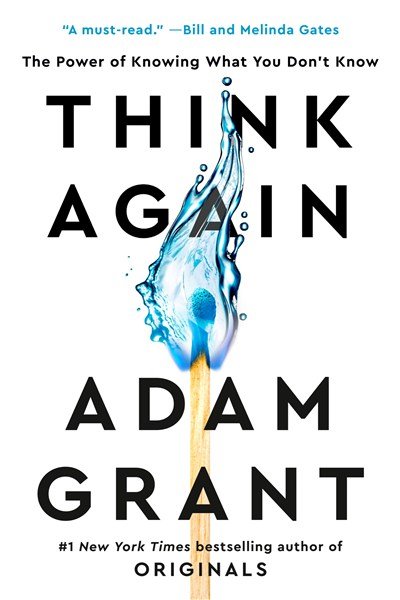
Organizational psychologist Adam Grant argues that in a fast-changing world, the ability to doubt what you know and update your opinions matters more than raw intelligence. Most people default to preacher, prosecutor or politician mode when their beliefs are challenged, defending, attacking or pandering instead of questioning. The fix is thinking like a scientist: treating opinions as hypotheses, actively seeking evidence you’re wrong and building relationships and cultures that reward rethinking rather than certainty.
⭐ The One Thing
The one thing this book taught me: identity should be built on values, not opinions. “Who you are should be a question of what you value, not what you believe.” When your sense of self is anchored to being right about a specific belief, changing your mind feels like losing part of yourself, so you defend the belief instead of testing it. Anchor identity to values like curiosity and truth-seeking instead, and updating a belief becomes a way of living your values, not a threat to them.
💭 First Impressions
The Dunning-Kruger material wasn’t new to me, but Grant’s twist reframed exactly where I should be watching for it: overconfidence peaks specifically in the transition from novice to amateur, not among true beginners. The BlackBerry case study landed harder than I expected, watching a brilliant engineer’s scientific rigor about hardware coexist with total rigidity about the market was an uncomfortably familiar pattern to recognize in myself. What stayed with me longest, though, was Grant reversing his own “strong opinions, weakly held” advice from an earlier book. It’s a rare moment where an author models the exact behavior the book is arguing for, in real time, instead of just describing it.
🔑 Key Concepts
• The Four Mental Modes: We default to preacher (defending sacred beliefs), prosecutor (attacking others’ arguments to win) or politician (currying favor with an audience) instead of scientist (testing ideas against evidence). Only scientist mode treats being wrong as a discovery rather than a defeat. The goal isn’t permanent residence in scientist mode, some situations call for conviction, but recognizing which mode you’ve slipped into is the prerequisite for choosing a different one.
• Confident Humility: The sweet spot between armchair-quarterback overconfidence and impostor-syndrome underconfidence. It separates belief in your capability (confidence) from certainty about your current methods or conclusions (humility), giving you “enough doubt to reexamine your old knowledge and enough confidence to pursue new insights.”
• Detachment as the Mechanism for Changing Your Mind: Two specific detachments make being wrong feel like discovery instead of loss: detaching your present self from your past self (so admitting an old belief was wrong doesn’t indict who you are now) and detaching your opinions from your identity (so a challenged belief isn’t a challenge to your worth). Daniel Kahneman’s line captures the target state: “My attachment to my ideas is provisional. There’s no unconditional love for them.”
• The Rethinking Cycle vs. the Overconfidence Cycle: Scientific thinking runs on humility, doubt, curiosity and discovery, which reinforces itself. Preacher, prosecutor and politician modes run the opposite loop: pride, conviction, confirmation-seeking and validation, which also reinforces itself but locks in whatever you already believed. Which cycle you’re in at a given moment is often more predictive of your judgment quality than your raw intelligence.
• Task Conflict vs. Relationship Conflict: Disagreement about ideas (task conflict) sharpens thinking and is worth pursuing directly, but it easily spills into disagreement about people (relationship conflict), which shuts rethinking down. A “challenge network” of disagreeable givers, people who push back because they want the work to improve, not because they want to win, keeps conflict productive instead of personal.
🧠 Mental Models & Frameworks
• Steel-Manning Over Straw-Manning: In any debate, negotiation or disagreement you actually want to resolve, engage the strongest version of the other side’s argument instead of attacking its weakest version. This earns credibility, reveals genuine common ground and lets you raise real concerns about the actual argument rather than a caricature of it.
• Asking “How” Instead of “Why”: Asking people why they hold a view tends to intensify commitment, since it prompts them to generate more justifications, while asking how they’d implement the view in practice exposes gaps in their understanding and naturally tempers the position. The same question works turned on yourself: test a strong opinion by asking how you’d actually execute it, not just why you believe it.
• The Rethinking Scorecard: Judge decisions by the quality of the process, how thoroughly alternatives were considered, rather than only the outcome. A bad process with a good outcome is luck, while a good process with a bad outcome might be a smart, well-reasoned experiment worth repeating.
• The Life Checkup: Just as you’d schedule a health checkup, schedule a periodic review of your goals, beliefs and commitments to see which ones you’re maintaining out of genuine conviction versus sunk-cost momentum. A recurring calendar reminder asking which current commitments you’d still choose if starting fresh today keeps this honest.
• Complexifying Instead of Polarizing: Treat a contentious topic as a prism with many facets rather than a coin with two sides. Naming nuance, caveats and competing considerations openly increases credibility and keeps an audience curious instead of defensive.
💬 My Favorite Quotes
Progress is impossible without change and those who cannot change their minds cannot change anything.
People who are right a lot listen a lot, and they change their mind a lot. If you don’t change your mind frequently, you’re going to be wrong a lot.
If you don’t look back at yourself and think, ‘Wow, how stupid I was a year ago,’ then you must not have learned much in the last year.
🙋 Who Should Read It?
• People whose past success has calcified into overconfidence: Experts, senior leaders or anyone with a long track record of being right, who now finds it hard to notice when the evidence has shifted. The BlackBerry case study is a direct mirror for this exact failure mode.
• Anyone trying to persuade people who currently disagree with them: Managers, salespeople, parents and advocates who keep reaching for stronger arguments and better data, only to watch the other side dig in further. The book’s debate, listening and motivational-interviewing chapters offer an alternative built on questions rather than force.
• Team leaders and educators building a culture around learning: People responsible for a classroom, team or organization who want people to surface disagreement and admit mistakes rather than hide them. The chapters on psychological safety, best practices and teaching kids to rethink are written directly for this audience.
🔗 Additional Resources
Books Referenced or Related:
• “Originals” by Adam Grant (source of the “strong opinions, weakly held” advice Grant reverses in this book)
• “Give and Take” by Adam Grant (referenced research on givers, takers and matchers)
• Research underlying the Dunning-Kruger effect, David Dunning and Justin Kruger’s original studies on skill and self-assessment
Research and Studies Cited:
• Meta-analysis of 95 studies on leadership self-assessment and gender differences in confidence
• Good Judgment forecasting tournaments (Philip Tetlock’s superforecaster research)
• Studies on motivational interviewing and its use in vaccine hesitancy and behavior change
• Research on happiness pursuit and its correlation with depression risk
Key People and Case Studies Featured:
• Mike Lazaridis and the BlackBerry/iPhone case study (scientific rigor in engineering, rigidity in market strategy)
• Daniel Kahneman (Nobel laureate psychologist, model of provisional belief-holding)
• Jean-Pierre Beugoms (amateur superforecaster who correctly predicted Trump’s 2016 nomination against expert consensus)
• Wagner Dodge (Mann Gulch fire, overriding well-learned survival responses)
• Ron Berger (education reformer, teaching students to revise drafts and question knowledge)
• Wright brothers (constructive conflict as a driver of the invention of flight)