

4 Skills To Make You Ridiculously Scalable As A Founder. The secret isn’t more effort.
Most founders never escape trading hours for money.
They work 80-hour weeks, build something real, grow revenue. But the moment they stop working, income stops. They’ve accidentally built themselves a high-paying prison where every dollar requires their direct effort, their active attention, their limited time.
You just built a job.
♾️ Avoid The Scalability Trap
Naval Ravikant calls working for money “renting out your time.” So what do most founders do when they want to grow? They double down on the things that don’t scale:
- Take on more clients personally (no systems to handle them)
- Add more services (creating more complexity you have to manage)
- Do everything yourself (to avoid the “expense” of outsourcing)
The problem? You can only:
- Take on so many clients before quality drops
- Add so many services before you lose focus
- Do so much yourself before something breaks
Usually your health. Sometimes your relationships. Always your growth.
There’s a better way.
The answer isn’t more hours. It’s building leverage. Assets that multiply your effort without multiplying your time.
According to Naval Ravikant, all leverage comes down to four skills, known as the 4 Cs of Leverage:
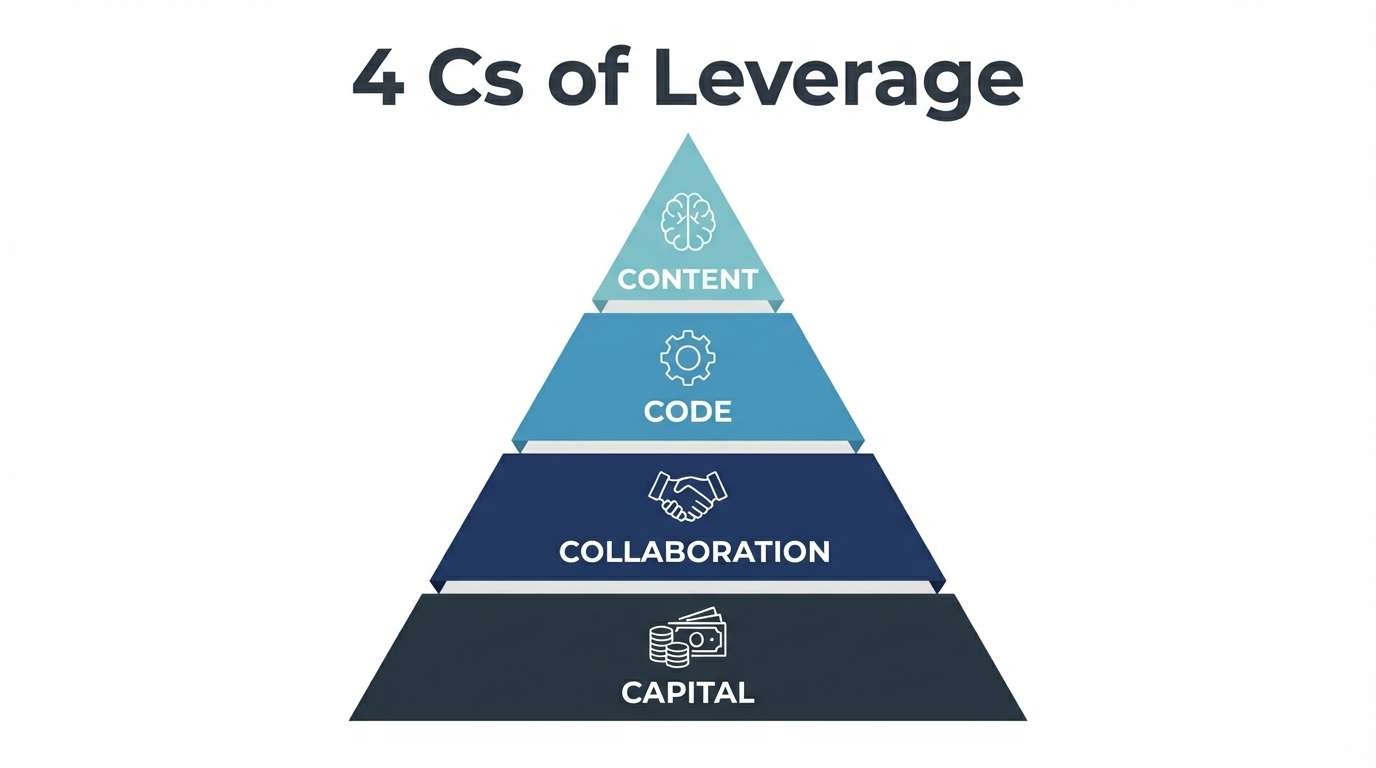
Mastering these four skills is what separates founders who scale from those who just survive.
Let’s break down each one.
🧠 #1 Leverage: Content
Content is how you clone your thinking at scale. And I mean that literally.
Most founders believe they need to be everywhere. Every meeting. Every deliverable review. Every decision. You become the bottleneck. Your business can only grow as fast as you can personally move.
But here’s what changes everything: content (documentation, SOPs, training videos, frameworks) allows other people to operate with your judgment without needing your presence. You’re not there, but your thinking is.
This is leverage because good content multiplies your decision-making ability. A well-written SOP lets five people execute your process simultaneously. A training video teaches your methodology to new hires forever. A framework document helps your team make decisions that align with your vision while you’re asleep.
Here’s the move: Document the next thing you’re about to teach someone. Don’t wait for the “perfect time” to build comprehensive documentation. Just start. Right now. With one process.
Record yourself doing it. Write down the decision criteria you actually use. Explain the “why” behind the “what.” That’s the part people always miss.
The format genuinely doesn’t matter. A 5-minute Loom video beats nothing. A bullet-point Google Doc beats tribal knowledge trapped in your head. The goal is simple: extract your expertise from your brain and put it somewhere other people can access it independently.
Real example: Levels Health (a $300M a16z-backed health tech startup) runs on documentation, not meetings. They created their entire press strategy as a single Notion memo in two days. No meetings required. New hires consistently report learning more about the company in two weeks than they did at their previous jobs in five years. That’s content leverage at scale.
⚙️ #2 Leverage: Code
Code is leverage in its purest form. You write it once, and it runs infinitely without needing you.
And no, this isn’t just about building the next SaaS unicorn. It’s about using software and automation to remove yourself from repetitive decisions. Every time you automate a task, you’re essentially creating a digital employee that works 24/7. No salary. No breaks. No management overhead.
Think about it. Software doesn’t sleep. A Python script can process your invoices at 3am while you’re actually sleeping. A Zapier workflow qualifies leads while you’re on vacation. That’s the power of leverage.
Here’s where to start: Look at your calendar from last week. What three tasks consumed the most time? Now ask yourself: “Could software do this?”
If you’re manually copying data between systems, you need Python or Power Automate. If you’re answering the same client questions over and over (and you know you are), build a chatbot. If you’re generating the same reports every Monday morning, write a script that does it for you.
You don’t need to be a developer. Tools like Zapier let you build powerful automation without writing code. But if you can learn basic Python? Even better. The goal isn’t perfection. It’s removing your time from the equation.
Real example: I watched a consulting firm spend 3 hours every week creating the same databooks for sales pitches. Same process. Every single week. Excel automation reduced it to 15 minutes. That’s 150+ hours reclaimed annually. From one automation. Imagine what ten automations could do.
🤝 #3 Leverage: Collaboration
Collaboration is the most misunderstood form of leverage. And honestly, it took me years to get this right.
This isn’t about “managing people” or “building a team.” It’s about understanding that other humans have skills, time and energy you don’t. When you work through people, you multiply what’s possible. You can be in ten places simultaneously. You can execute on ideas your skills don’t cover. You can build things bigger than yourself.
The mistake most founders make? Trying to clone themselves. They hire people and then micromanage them into doing things exactly their way. That’s not leverage. That’s just expensive delegation with extra steps.
True collaboration leverage means hiring people who are better than you at specific things and letting them operate independently. You’re not trying to scale yourself. You’re trying to scale outcomes by combining diverse capabilities. Big difference.
Start here: What skill gaps are actually holding your business back? Not the gaps you think you “should” work on. The real ones. What can’t you do well? What do you actively avoid because it drains you? Those are your collaboration opportunities.
Don’t hire generalists who “do a bit of everything.” Hire specialists who are exceptional at one thing. A world-class designer. A conversion-focused copywriter. A data analyst who genuinely loves spreadsheets. Let them do what they do best while you do what you do best.
Real example: Charisma on Command founders struggled until splitting into their zones of genius — Charlie creating videos, Ben handling operations. The channel exploded to almost 7 million subscribers (making it one of YouTube’s largest personal development channels). Operating in their zone of genius built a multi-million dollar empire.
💵 #4 Leverage: Capital
Capital is leverage because it lets you deploy resources you couldn’t create yourself. But most entrepreneurs completely misunderstand this.
They think “I don’t have capital to deploy.” I get it. You’re bootstrapped. You’re profitable but lean. But here’s what I’ve learned: capital isn’t just about millions in VC funding. It’s about understanding that money can buy back your time and accelerate outcomes you couldn’t achieve alone.
Hiring someone to handle client admin frees you to close deals. Paying for software eliminates manual work. Investing in advertising scales customer acquisition beyond your personal network. Money converts into time. Time converts into more money. That’s the loop.
Try this exercise: Calculate your effective hourly rate. Take your annual target income and divide by 2,000 hours. Now look at your calendar. Any task worth less than your hourly rate should be delegated, automated or eliminated. Period.
If you’re worth $100/hour and you spend 5 hours on bookkeeping, you just cost yourself $500 in opportunity cost. Hire a bookkeeper for $150 and use those 5 hours to generate $500 in new revenue. That’s what leverage looks like in practice.
The barrier isn’t usually money. It’s mindset. We resist spending money to buy time because we can “do it ourselves.” I’ve been there. But doing it yourself is the opposite of leverage. It’s the thing keeping you stuck.
Real example: A consultant making $150k annually spent 10 hours weekly on proposal formatting. He finally hired a VA for $15/hour to handle it. Then he reinvested those 10 hours into actual client work. Added $50k in revenue that year. The VA paid for herself 10x over. He kicked himself for waiting so long.
🔓 Unlocking The Power of Leverage
So, what does building leverage actually mean for you as a founder?
Leverage creates compound interest. Every piece of content teaches indefinitely. Every automation saves time forever. Every collaboration extends your capabilities permanently. Every dollar deployed generates returns repeatedly.
“All returns in life, whether in wealth, relationships, or knowledge, come from compound interest.” — Naval Ravikant
The founders who build income while they sleep aren’t lucky or smarter. They’re intentional about building leverage into everything they do. They constantly ask: “How can I create this once and benefit from it repeatedly?”
Start with one of the 4 Cs. Document one process. Build one automation. Hire one specialist. Deploy capital into one time-saving tool.
These four skills can be learned. Master the 4 Cs of Leverage, and you remove all constraints on what you can build.
The only question is: will you?