
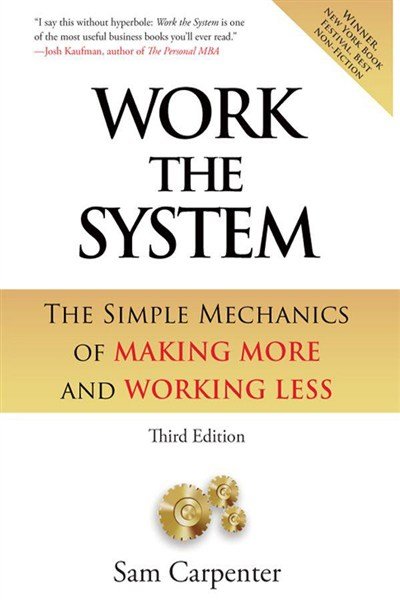
⚡ The Lightning Summary
Every business and life is really a bundle of separate, fixable systems, not a single chaotic mess. Stop reacting to fires and start isolating each system, writing down the one best way to run it, then maintaining that document. The payoff, proven by the author’s own 2-hour workweek, is control that compounds instead of effort that burns out.
⭐ The One Thing
The one thing this book taught me: a fix that isn’t written down isn’t actually a fix. Without documentation, every improvement quietly reverts under pressure, deadlines, fatigue, whoever’s covering for you that day. Writing the solution down is what converts a one-time save into a permanent gain.
💭 First Impressions
One idea in this book I’m still not fully sold on is Carpenter’s claim that quantity of communication drives quality, it runs directly against nearly every other productivity book I’ve read, which preaches the opposite. What did land, though, was the 98 percent “good enough” standard, it gave me explicit permission to stop polishing things nobody actually asked to be polished. My biggest reservation is that every concrete proof point in the book comes from one business built almost perfectly for documentation to work, which left me questioning how well “any recurring problem can be solved with a system” actually holds up elsewhere.
🔑 Key Concepts
• The Systems Mindset: Every business, job and life is a collection of separate, mechanical systems, not one indivisible blob of chaos. Adopting an “outside and slightly elevated” observer position lets you see, isolate and fix each system individually instead of reacting moment to moment to whatever problem is loudest.
• Fire Killing vs. Fire Prevention: Constantly solving urgent problems as they erupt feels heroic but is actually the trap that keeps you in reactive mode forever. The fix is tracing every recurring problem back to the system that produced it and permanently repairing that system so the same fire can’t restart.
• The Three-Document Framework: A Strategic Objective (one page, overall direction), General Operating Principles (a short list of decision-making guidelines) and Working Procedures (step-by-step documentation of every recurring process) convert fragile, personality-dependent “organic” processes into reliable mechanisms that produce the same result no matter who executes them.
• Errors of Omission: Most damage in a business or a life doesn’t come from active mistakes, it comes from things simply not done: the bill not paid, the call not returned, the exercise not taken. Recognizing inaction as an active choice, not a passive default, reframes procrastination as a decision with traceable consequences.
• The 98 Percent “Good Enough” Standard: Perfection is redefined as 98 percent accuracy, not 100 percent, because the effort required to chase that last 2 percent is itself a form of waste, time and energy pulled away from higher-value system improvement elsewhere.
🧠 Mental Models & Frameworks
• The Outside-and-Slightly-Elevated Perspective: Whenever you feel overwhelmed and are reacting to problems as they hit, mentally step outside the day’s events and observe your systems from above, as separate, distinct mechanical entities rather than being enmeshed inside them. When you feel buried, ask which specific system produced this outcome instead of just reacting to the outcome itself.
• Isolate, Fix, Maintain: For any recurring problem, personal or professional, work a three-step cycle: separate the system from everything else happening around it, repair and document it, then perform light ongoing maintenance. Effort shifts from fixing toward maintaining as systems mature, so write out the actual linear steps of a recurring pain point before trying to solve it.
• The Circle of Influence: Borrowed from Stephen Covey, this focuses your limited time and energy exclusively on what’s inside your current circle of influence rather than on big-picture problems you can’t control. That focus, not worrying about what’s outside it, is what expands the circle over time, so audit where your attention actually goes each week and redirect it toward what you control directly.
• Point-of-Sale Thinking: Named after retail cash registers, this treats every task or transaction as something to be fully resolved the moment it occurs rather than left as a loose end to revisit later. Processing requests to completion on first contact eliminates the hidden cost of reopening the same item multiple times.
• Prime Time (Biological and Mechanical): Identify your Biological Prime Time, the few hours when your energy and focus naturally peak, and dedicate that window exclusively to your highest-value Mechanical Prime Time work, protected from low-value tasks. Block your natural peak-energy hours for deep, system-building work only, moving routine admin to lower-energy windows.
💬 My Favorite Quotes
First you work your systems, then your systems do the work.
Unhappy people are not in control of their lives because they spend their days coping with the unintentional bad results of unmanaged systems. Happy people are in control of their lives, spending their days enjoying the intentional good results of managed systems.
Independence and wealth occur after the mechanics are in place.
🙋 Who Should Read It?
• Small business owners drowning in day-to-day firefighting: You’re working sixty to a hundred hours a week, revenue is growing but take-home pay isn’t, and every fix you make is temporary because the next fire is already starting. You need a structural alternative to simply working harder.
• Managers whose team runs entirely on their personal memory and availability: Nothing in your department is written down, decisions depend on you being physically present, and a single sick day or vacation creates a backlog. You need the documentation habit this book is built around.
• Anyone who feels chronically stressed and out of control in daily life, not just at work: You want a concrete, mechanical framework for regaining control rather than a motivational or therapeutic one. The book explicitly separates the mechanical from the emotional and asks you to fix the mechanics first.
🔗 Additional Resources
Books Referenced or Related:
• “The 7 Habits of Highly Effective People,” “First Things First” and “The 8th Habit” by Stephen Covey
• “Good to Great” by Jim Collins
• “The E-Myth Revisited” by Michael Gerber
• “Awaken the Giant Within” by Anthony Robbins
• “The Personal MBA” by Josh Kaufman (foreword author)
• “The 4-Hour Workweek” by Timothy Ferriss (referenced and contrasted with “lifestyle design”)
• “Treating Type A Behavior and Your Heart” by Meyer Friedman
• “Full Catastrophe Living” by Jon Kabat-Zinn
Concepts and Frameworks Referenced:
• Ockham’s Razor / the Law of Economy (William of Ockham)
• Stephen Covey’s Circle of Influence and time-management matrix
• Franklin-Covey planning methodology
Related People and Case Studies:
• Centratel, Carpenter’s own telephone answering service and the book’s central case study
• Josh Kaufman, foreword author
• Mike Giles, Carpenter’s business partner and co-creator of the Work the System Academy
Companion Programs:
• Work the System Academy (workthesystem.com), video training program for implementing the method with staff
• Work the System Consultant program, training for those who want to teach the methodology to others