
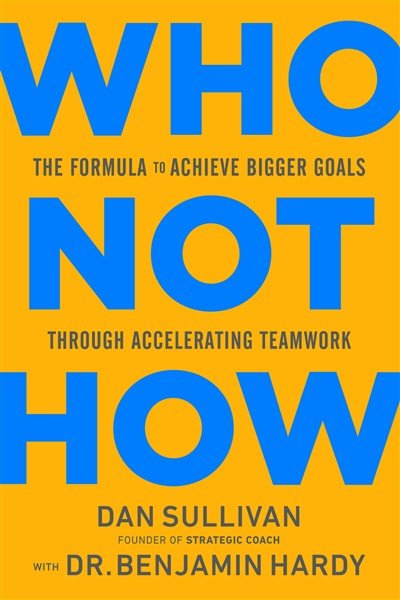
⚡ The Lightning Summary
Stop asking “How can I accomplish this?” and start asking “Who can help me achieve this?” This fundamental shift unlocks exponential growth in time freedom, income potential, relationship quality and life purpose by replacing linear self-execution with collaborative leverage through capable people who expand your vision and resources.
⭐ The One Thing
The one thing this book taught me: Your potential is not limited by your capabilities, it’s limited by your willingness to find the right Whos. Every goal becomes achievable and every vision becomes expansive when you shift from trying to figure out how to do everything yourself to identifying who can achieve it better, faster and with less personal time investment.
💭 First Impressions
The reframing of procrastination as wisdom rather than weakness was genuinely revolutionary—the idea that your resistance to a task is your inner genius saying “you’re not the one to do this” transforms guilt into strategic thinking about resource allocation. Michael Jordan’s story hit hard because even the most driven individual on the planet needed Whos (Phil Jackson, Scottie Pippen, Tim Grover) to achieve greatness; if MJ couldn’t do it alone, the lone wolf mentality is clearly delusional. The Cost vs Investment mindset shift felt uncomfortable because it forces you to confront how much potential income and freedom you’ve sacrificed by being cheap with delegation—Carl’s story of spending hundreds of hours learning to code when a developer would charge £1,200 was painful to read.
🔑 Key Concepts
-
Who Not How Philosophy: The fundamental shift from asking “How do I do this?” to “Who can do this for me?” transforms goals from linear, time-consuming burdens into exponential, collaborative opportunities. “How” keeps you trapped in your existing knowledge and capabilities while “Who” gives you instant access to expertise, resources and perspectives you don’t possess.
-
The Four Freedoms Framework: All entrepreneurial and personal success can be measured across four dimensions: Freedom of Time (reclaiming hours by delegating tasks), Freedom of Money (earning capacity increases when time is freed), Freedom of Relationship (surrounding yourself with higher-caliber collaborators) and Freedom of Purpose (expanded vision for what’s possible). Each freedom builds on and reinforces the others.
-
Procrastination as Wisdom: Procrastination is not a character flaw or lack of willpower—it’s your subconscious recognizing that you’re not the optimal person to execute a particular task. The solution is not self-discipline or time management hacks; it’s finding the right Who to take ownership of what you’ve been avoiding.
-
Technical vs Adaptive Problems: Technical problems have known solutions and can be delegated to experts (building a website, setting up systems, managing logistics). Adaptive problems require your unique thinking, creativity and vision (strategic decisions, creating content, defining company culture). Entrepreneurs should focus exclusively on adaptive problems and delegate all technical ones.
-
Investment vs Cost Mindset: Viewing Whos as costs leads to transactional, short-term thinking and keeps you trapped doing low-value work. Viewing Whos as investments creates transformational relationships where both parties grow and enables you to focus on high-value activities that multiply your impact and income.
🧠 Mental Models & Frameworks
-
The Impact Filter: Use this before any new project or goal. Complete a one-page document answering: What is the project? What’s the purpose? What’s the importance? What does ideal completion look like? What’s the best result if you act? Worst result if you don’t? What are the success criteria? This clarifies your own thinking first, then communicates the vision to potential Whos so they can self-select if they’re the right fit.
-
The Moving Future (90-Day Process): Use this every quarter to maximize time and progress. Reflect on past 90 days’ achievements, identify current areas of focus and confidence, anticipate next quarter’s exciting developments, define five new “jumps” that would make the quarter great regardless of other outcomes. Each 90-day cycle is an opportunity to eliminate more Hows by adding Whos, progressively freeing up time and expanding vision.
-
The 80% Rule: Use this when perfectionism is slowing progress. Getting from 0 to 80% of a project is relatively quick. Going from 80% to 90% is exponentially more work. Getting from 90% to 100% is a mountain. Do your 80%, then pass it to the next Who for their contribution. Publish imperfect work, get feedback fast and let collaboration transform the output rather than perfecting it alone.
-
Self-Expansion Model: Use this when evaluating relationships and growth opportunities. Human motivation centers on self-expansion, which occurs through relationships that provide new resources, perspectives and capabilities. Attraction to people is based on desirability (potential for expansion) and probability (likelihood of forming the relationship). Measure progress by the amount and quality of collaborations happening in your life, not by individual achievements.
-
Transformational Leadership: Use this when leading teams and delegating with autonomy. Four pillars: Individualized Consideration (mentor each person), Intellectual Stimulation (challenge assumptions, encourage creativity), Inspirational Motivation (articulate compelling vision), Idealized Influence (model high ethical standards). Provide extreme clarity on the vision and success criteria, then give Whos complete autonomy over how they execute.
💬 My Favorite Quotes
How is linear and slow. Who is non-linear, instantaneous and exponential.
Personal confidence comes from making progress toward goals that are far bigger than your present capabilities.
Delegate everything except genius.
🙋 Who Should Read It?
-
Entrepreneurs and business owners drowning in operational tasks who know they should be focusing on strategy and growth but can’t seem to extract themselves from the day-to-day execution, feeling like they’re the only ones who can do things “right” and suffering from chronic overwhelm and stunted business growth.
-
High achievers who procrastinate on important goals because they’re paralyzed by the enormity of the “how” and need permission to stop being a solo operator. If you have ambitious visions but keep them small because you’re the bottleneck, this book rewires your thinking about what’s possible through collaboration.
-
Professionals making good money but trading massive amounts of time for it, stuck in the “time and effort economy” where income is directly tied to hours worked. If you want to shift to the “results economy” where you’re compensated for outcomes rather than inputs, this provides the mental models and practical frameworks.
🔗 Additional Resources
Related Books and Authors:
- Strategic Coach program by Dan Sullivan (entrepreneurial coaching framework)
- Self-Determination Theory (autonomy, competence and relatedness research)
- Transformational Leadership Theory (organizational psychology)
- Self-Expansion Model by Arthur and Elaine Aron (relationship psychology)
Key Concepts Referenced:
- Decision fatigue (psychological research on willpower depletion)
- Fundamental attribution error (over-attributing outcomes to personality vs situation)
- Unique Ability concept (identifying your zone of genius)
- Results Economy vs Time and Effort Economy
Tools and Frameworks:
- Impact Filter (one-page vision clarification tool)
- Moving Future (90-day planning process)
- “What I Want” journaling practice
- 80% rule for project completion