⚡ The Lightning Summary
Executive effectiveness isn’t about intelligence or charisma, it’s learnable discipline. Master five practices: systematic time management, contribution focus, strength-building, priority concentration and systematic decision-making. Transforms knowledge workers from busy activity into meaningful results through systematic practices rather than natural talent.
⭐ The One Thing
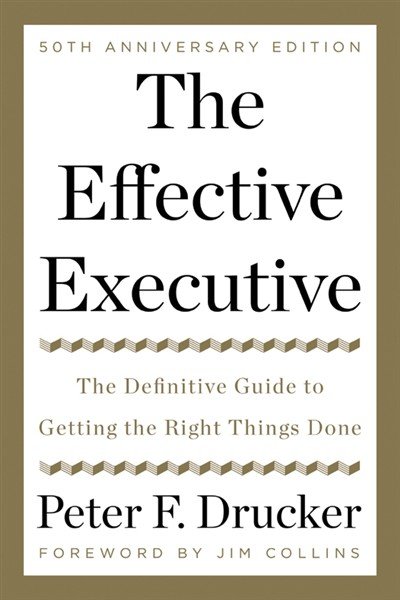
The one thing this book taught me: Effectiveness is not about personality, intelligence or natural talent – it’s a learnable discipline consisting of systematic practices that transform knowledge work into results. Focus on contribution, manage your time deliberately, build on strengths, concentrate on priorities and make decisions systematically.
💭 First Impressions
This book feels remarkably current despite being written decades ago, demonstrating Drucker’s profound understanding of timeless management principles. The focus on contribution over activity provides a powerful antidote to the busyness trap that plagues modern knowledge work. What surprised me most is how Drucker reframes effectiveness from a personality trait to a learnable skill set that anyone can develop through practice.
🔑 Key Concepts
-
Effectiveness vs Intelligence: Brilliant people are often ineffective because they confuse insight with achievement, while effective “plodders” systematically convert knowledge into results through disciplined work habits and focus on contribution rather than effort.
-
Time as the Limiting Resource: Time is irreplaceable, non-renewable and the scarcest resource that determines all other outputs. Effective executives record, manage and consolidate their time into large continuous blocks rather than fragmenting it into small, unproductive pieces.
-
Focus on Contribution: Asking “What can I contribute?” shifts attention from internal activities and personal skills to external results and organizational performance, creating the foundation for effective human relations, teamwork and self-development.
-
Building on Strengths: Organizations and individuals achieve results by maximizing strengths rather than trying to overcome weaknesses. Place people where their strengths can be productive and design jobs around what people can do exceptionally well.
-
Systematic Decision-Making: Effective decisions require deliberate disagreement to avoid groupthink, clear boundary conditions, built-in implementation steps and systematic follow-up to test assumptions against reality.
🧠 Mental Models & Frameworks
-
Time Recording and Analysis: Use this when feeling overwhelmed or unproductive. Track where time actually goes for 3-4 weeks, identify time-wasters, eliminate non-essential activities, delegate what others can do better, consolidate remaining time into large blocks. Apply this quarterly to prevent drifting back into ineffective time usage patterns.
-
Contribution Focus Questions: Use this before starting any significant work or joining meetings. Ask: “What can I contribute that will significantly affect performance and results? What results are expected of me? How can this serve the organization’s goals?” Apply this framework to transform from effort-focused to results-focused work approach.
-
Strength-Based Staffing: Use this when hiring, promoting or assigning work. Identify what the person can do uncommonly well, design roles around maximum strength utilization, make weaknesses irrelevant through proper positioning. Use this to build teams where everyone operates from their zone of excellence.
-
Priority Setting with Posteriorities: Use this when facing multiple competing demands. Set posteriorities (what NOT to do) before priorities, concentrate on one major task at a time, abandon yesterday’s priorities when circumstances change. Apply this to maintain focus and avoid multitasking illusions.
💬 My Favorite Quotes
Intelligence, imagination, and knowledge are essential resources, but only effectiveness converts them into results.
There is surely nothing quite so useless as doing with great efficiency what should not be done at all.
We are all incompetent at most things. The crucial question is not how to turn incompetence into excellence, but to ask, ‘What can a person do uncommonly well?’
🙋 Who Should Read It?
-
Knowledge workers feeling overwhelmed by competing demands who want to move from being busy to being effective, particularly those struggling to translate expertise into meaningful organizational results despite working long hours and staying constantly busy with activities that don’t move the needle.
-
New managers and executives transitioning from individual contributor roles who need systematic frameworks for focusing their efforts and managing their expanded responsibilities without burning out. Your technical skills got you promoted but now you face time fragmentation, people management and strategic decisions you weren’t trained for.
-
Experienced professionals plateauing in their careers who possess technical competence but struggle to create significant impact or advancement opportunities within their organizations. You’re good at your job but not moving up because effectiveness (doing right things) matters more than efficiency (doing things right) at senior levels.
🔗 Additional Resources
Key Figures and Case Studies:
- Alfred Sloan’s management practices at General Motors (systematic decision-making and meeting follow-up)
- Harry Truman’s presidency (focusing on what needs to be done vs. what one wants to do)
- Franklin D. Roosevelt’s “adversary proceedings” (ensuring disagreement and multiple perspectives)
- Jack Welch at General Electric (focusing on what needs to be done rather than personal preferences)
Connected Concepts:
- Management by objectives (translating contribution focus into measurable results)
- Knowledge worker productivity research (understanding effectiveness challenges in information-age work)
- Time management methodologies (recording methods and analysis frameworks)
Related Books:
- “The Drucker Management Series” (Drucker’s other foundational works)
- “Deep Work” by Cal Newport (protecting time for concentrated effort)
- “The One Thing” by Gary Keller (priority concentration and focus)
- “Good to Great” by Jim Collins (getting the right people in the right seats)