
⚡ The Lightning Summary
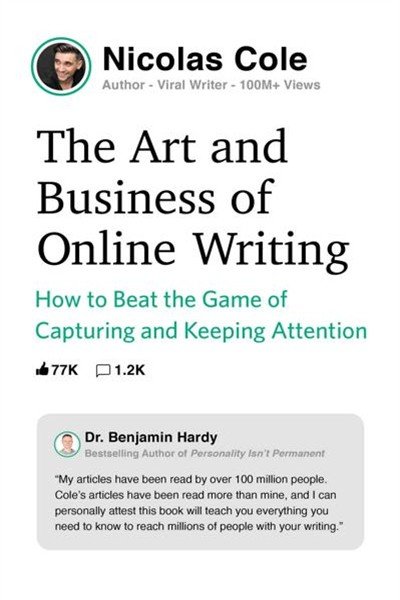
Most writers fail online because they treat writing like an art instead of a game. Nicolas Cole went from teenage gaming blogger to the #1 writer on Quora (300M+ users) by understanding that capturing and keeping attention online follows game mechanics. Master the seven levels (Conscious Play, Category, Style, Speed, Specificity, Credibility, Category Creation), publish on platforms with existing audiences, use data to guide your writing, and monetize through advertising, exclusivity, or services. Success comes from practicing in public and optimizing based on immediate feedback.
⭐ The One Thing
The one thing this book taught me: Writing online is a game with specific rules, and the winners are those who play consciously. Stop treating your writing as sacred art that must be perfected in private. Instead, practice in public, use data to guide your decisions, and optimize for capturing attention quickly (Rate of Revelation). The fastest path to improvement is publishing daily and letting readers tell you what they want more of.
💭 First Impressions
The 1/3/1 structure is deceptively simple but immediately applicable to everything I write. What struck me most was Cole’s gaming background giving him this unique lens for understanding online writing. It really is a game with rules, levels and mechanics, and once you see it that way, the path forward becomes clearer. This is also the first book I’ve read that honestly acknowledges writing must be combined with entrepreneurship to succeed financially, rather than pretending that quality alone will magically attract an audience and income.
🔑 Key Concepts
-
Writing Online Is A Game: Every person on the internet is playing “the game” whether they realize it or not. Successful writers play consciously with clear strategies. Unsuccessful writers play unconsciously and wonder why they’re not succeeding. Understanding the rules, levels and mechanics transforms your results because you’re optimizing for what actually works rather than what you think should work.
-
Practice In Public: The fastest way to improve is to publish regularly and gather immediate feedback. Waiting for perfection kills momentum. Musicians practice on street corners, writers should practice online. Every piece of content is data collection. Your first 100 posts are tuition; you’re learning what works by testing in the real market, not theorizing in isolation.
-
The Seven Levels of Success: 1) Play consciously vs unconsciously. 2) Choose your category. 3) Define your style on the Educating-Entertaining spectrum. 4) Optimize for speed (Rate of Revelation). 5) Master specificity to stand out. 6) Engineer three types of credibility (Implied, Perceived, Earned). 7) Create your own category. Most writers get stuck at Level 2-3 and never progress to category creation where the real money lives.
-
Don’t Start A Blog: New blogs have zero traffic, require skills unrelated to writing (SEO, ads, social media), have no discovery mechanism and lack social components. Instead, write on platforms with existing audiences (Quora, Medium, LinkedIn). Blogs are businesses, not writing. Only start a blog after you’ve built credibility and audience elsewhere. This principle alone saves writers years of frustration.
-
Data Over Intuition: Use metrics (Views, Likes, Shares, Comments) to inform your writing decisions. The “Writing Data Flywheel”: Publish, Gather Data, Refine, Publish Better Content. Track which topics, headlines and structures perform best. What worked yesterday may not work tomorrow. Successful writers are scientists running experiments, not artists hoping for inspiration.
🧠 Mental Models & Frameworks
-
The Writing Spectrum: All writing exists on a spectrum from Educating to Entertaining. Your unique style comes from being unexpected in your category. If everyone in your niche is purely educational, add entertainment. If everyone entertains, educate. Find your position through data and experimentation, then map your category to identify where competitors sit and position yourself at the unexpected spot to stand out.
-
The Content Buckets System: Identify 3-5 high-performing topic areas that attract specific reader interests. Track which buckets get the most engagement. Double down on winners, eliminate losers. Use buckets to organize your “Sticky Web” from free to paid content. Analyze your top 20 posts, group them into themes, identify your 3-5 strongest buckets, then create a content roadmap around these proven winners.
-
The 1,000 True Fans Model: You don’t need millions of readers. 1,000 fans multiplied by $100/year equals $100,000 income. Focus on depth of relationship, not breadth of reach. Loyal fans buy multiple products, refer friends and provide stability. Instead of chasing viral hits, focus on converting engaged readers into True Fans through email list, exclusive content and genuine relationship building.
-
Category Creation Formula: Categories are created at unlikely intersections. Audience x Genre (Historical fiction for veterans), Genre x Genre (Sci-fi memoir), or Audience/Genre x Tone (No-BS self-help). Different always beats Better. Map your expertise, identify unusual combinations, position yourself at intersection where no one else plays and become the definitive voice in that micro-category.
-
The Writing Data Flywheel: 1) Publish content 2) Gather data (views, engagement) 3) Analyze what resonated 4) Refine approach 5) Publish better content 6) Repeat infinitely. Each iteration compounds knowledge. Track every post’s performance in a spreadsheet, identify patterns in top performers, systematically test variables and optimize based on evidence rather than gut feeling.
💬 My Favorite Quotes
There are 2 types of writers today: those who use data to inform and improve their writing, and those who fail.
DIFFERENT always beats Better.
Somewhere, someone else is practicing harder than you, faster than you, longer than you. They want it more than you. And when you meet them, they will win.
🙋 Who Should Read It?
-
Aspiring writers who want to build an audience and make money online but don’t know where to start, or bloggers frustrated by zero traffic despite publishing consistently who need to understand why blogs fail and social platforms succeed.
-
Content creators stuck at 500-5,000 followers who can’t break through to the next level and need the seven-level framework, or anyone who’s written for free for years and wants to finally monetize through advertising, exclusivity, or services.
-
Marketing professionals, coaches and consultants who need to master online writing for personal brand building, client attraction, or content strategies. Anyone told “just write good content” who needs tactical frameworks for headlines, structure and distribution.
🔗 Additional Resources
Books Referenced:
- Kevin Kelly – “1,000 True Fans” essay (foundational concept for creator economy)
- Seth Godin – Permission marketing and niche domination concepts
- Malcolm Gladwell – Example of Pop Science category creation
Platforms Mentioned:
- Quora – 300M+ users, best for How-To and advice content
- Medium – 30M+ users, ideal for opinion columns and essays
- LinkedIn – Business, productivity, and technology content
- Wattpad – Fiction writing platform (1.5B+ reads)
- Twitter – Micro-content and audience building
Concepts to Explore Further:
- The Writing Data Flywheel and analytics tracking
- Category creation and positioning theory
- Platform algorithms and content discovery
- Email list building and newsletter monetization
- Ghostwriting and corporate content services