
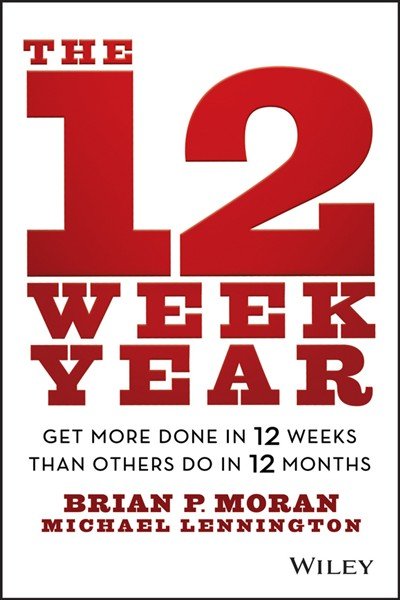
⚡ The Lightning Summary
Traditional 12-month annual planning creates a false sense of time abundance that leads to procrastination. By redefining a “year” as 12 weeks, you create sustained urgency and achieve exponentially better results through five execution disciplines: vision, planning, process control, measurement and time use. Most people can double or triple results by consistently executing what they already know.
⭐ The One Thing
The one thing this book taught me: Execution happens daily and weekly, not annually. Every week matters, every day counts. You become great in the moment you choose to do what needs to be done, long before the results confirm it.
💭 First Impressions
The 85% rule clicked immediately – you don’t need perfection to achieve excellence, executing 85% of weekly tactics likely achieves 12-week goals. The system is immediately actionable, simple enough to implement this week rather than someday when conditions are perfect. What stands out is how refreshingly honest the book is about discomfort – it doesn’t promise easy, it promises effective by choosing important actions over comfortable ones.
🔑 Key Concepts
-
Annualized Thinking Is the Enemy: The belief that there is “plenty of time” in a year leads to procrastination and lack of urgency. People postpone critical actions thinking they can catch up later. By the time urgency kicks in (November/December), it’s too late to recover. The solution is thinking in 12-week cycles where every week matters and creates sustained focus without the false sense of abundance that 12 months creates.
-
The Execution Gap: The primary barrier to success is not lack of knowledge but lack of execution. Most people can double or triple their results by consistently applying what they already know. Knowledge without action is powerless. The marketplace rewards implementation, not ideas. This gap exists because people focus on acquiring more knowledge rather than executing existing knowledge with discipline and consistency.
-
Periodization – The Athletic Training Principle: Borrowed from Olympic training methodology, periodization means focusing intensely on specific skills for limited periods (4-6 weeks in athletics, adapted to 12 weeks for business and personal success). This creates breakthrough results through concentrated effort. Athletes don’t train for everything simultaneously; they focus on specific capacities for limited periods to achieve peak performance. The same principle applied to work and life enables exponential improvements.
-
Three Core Principles: Accountability means ownership of choices and results, not consequences. It’s recognizing you create your circumstances through decisions. Commitment means personal promises that build character and success. When you’re interested, you do things when circumstances permit; when committed, you accept no excuses, only results. Greatness in the Moment means choosing to do what’s necessary right now, not waiting for future conditions. Results don’t create greatness; they confirm it. You become great the moment you choose greatness.
-
Five Execution Disciplines: Vision creates compelling emotional connection to desired future, making difficult actions worthwhile. Planning translates vision into 12-week tactical plans with specific measurable actions. Process Control uses tools and events (weekly plans, WAMs) that ensure consistent execution. Measurement tracks execution weekly (aim for 85% completion), not just results. Time Use applies intentional time blocking (strategic, buffer and breakout blocks) to ensure important work gets protected time rather than leftover time.
🧠 Mental Models & Frameworks
-
The 85% Execution Rule: Use this when setting performance standards and self-evaluation. You don’t need perfection to achieve excellence. Executing 85% of your weekly plan tactics will likely achieve your 12-week goals. This removes the pressure of perfectionism while maintaining high standards. It accounts for life’s unpredictability while ensuring sufficient consistency for breakthrough results. Track weekly execution percentage and if consistently below 85%, reduce the number of tactics rather than lowering standards.
-
Interest vs. Commitment: Use this when evaluating your own follow-through and others’ likely behavior. “When you’re interested in doing something, you do it only when circumstances permit. When you’re committed to something, you accept no excuses, only results.” Interest is conditional; commitment is unconditional. True commitment requires strong desire, keystone actions, counting costs and acting despite feelings. Before starting any goal, honestly assess whether you’re interested or committed – if interested, either upgrade to commitment or acknowledge you won’t follow through when things get hard.
-
Productive Tension as Fuel: Use this when feeling discomfort about unexecuted plans. The discomfort of not executing your plan is beneficial, not something to avoid. This tension can either make you quit or propel you forward. High performers use productive tension as fuel for action rather than a signal to lower standards. When feeling discomfort about incomplete tasks, recognize it as productive tension signaling the gap between current state and desired state. Use it as motivation to act rather than signal to adjust goals downward or quit.
-
Intentional Imbalance: Use this when feeling guilty about neglecting life areas or trying to “balance” everything equally. Life balance doesn’t mean equal time in all areas. Different seasons require different focus. Each 12 weeks you can focus on 1-2 key life areas and make significant progress, then shift focus next cycle. Trying to improve everything simultaneously leads to mediocre results everywhere. Accept that other areas will receive maintenance-level effort, and that’s okay for 12 weeks.
-
Vision as Mental Creation: Use this when struggling to take difficult actions or maintain motivation. You create things twice—first mentally, then physically. The biggest barrier to high performance is not the physical manifestation but the mental creation. Vision activates the prefrontal cortex and neuroplasticity trains your brain to act on what you imagine. Spend 15 minutes daily visualizing your desired future with emotional intensity, including sensory details and feelings, not just outcomes.
💬 My Favorite Quotes
Most of us have two lives: the lives we live and the lives we are capable of living.
When you’re interested in doing something, you do it only when circumstances permit, but when you’re committed to something, you accept no excuses, only results.
If we take care of the minutes, the years will take care of themselves.
🙋 Who Should Read It?
-
Entrepreneurs and business owners who set ambitious annual goals but consistently end the year feeling they underperformed, or high achievers experiencing the execution gap who know what to do but struggle to consistently do it.
-
Knowledge workers feeling overwhelmed by competing priorities who need a framework to focus on what truly moves the needle, or people struggling with procrastination rooted in “plenty of time left” thinking.
-
Managers and team leaders responsible for driving consistent performance from others who need simple, measurable accountability systems, or anyone trapped in annual planning rituals that provide little daily guidance.
🔗 Additional Resources
Foundational Concepts Referenced:
- Periodization training methodology from Olympic athletics
- Benjamin Franklin’s time management principles
- Neuroplasticity and prefrontal cortex research on vision and goal achievement
- Behavioral psychology on commitment and accountability
- Research on peer support groups increasing success rates by 7x
Complementary Books:
- “Atomic Habits” by James Clear (building systems that support execution)
- “Deep Work” by Cal Newport (strategic time blocking and focused work)
- “The One Thing” by Gary Keller (focusing on highest-leverage activities)
- “Measure What Matters” by John Doerr (OKR framework with similar measurement principles)
- “High Performance Habits” by Brendon Burchard (habits of top performers)
- “Getting Things Done” by David Allen (tactical task management to complement strategic planning)
- “The 4 Disciplines of Execution” by Chris McChesney (organizational execution framework)
Mental Models and Frameworks:
- OKRs (Objectives and Key Results) – similar quarterly/cyclical approach
- Agile methodology – iterative cycles with regular reviews
- Pareto Principle (80/20 rule) – focusing on highest-impact activities
- Eisenhower Matrix – distinguishing important from urgent
- SMART goals framework – specific, measurable, achievable, relevant, time-bound