⚡ The Lightning Summary
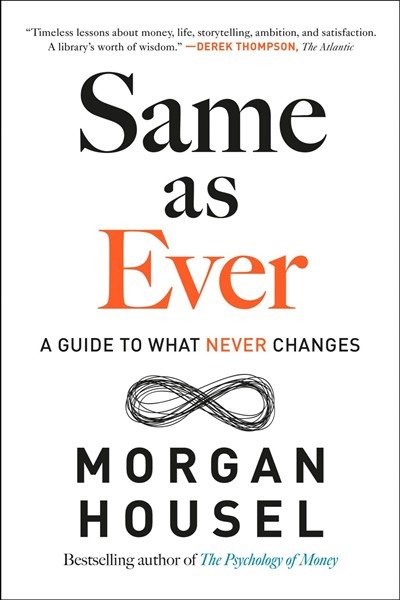
Stop trying to predict the future by forecasting events. Instead, predict human behavior because people respond to greed, fear, risk, opportunity and social persuasion the same way they did hundreds of years ago. The world changes constantly, but human nature remains remarkably consistent. Focus on understanding what never changes rather than chasing what’s new.
⭐ The One Thing
The one thing this book taught me: In a thousand parallel universes, the things that would be true in every single one are not about what technology exists or which companies dominate, but how humans behave when facing risk, uncertainty, greed, fear and opportunity. That timeless behavior is what you should bet on.
💭 First Impressions
The book feels like a masterclass in shifting perspective – where most business books chase trends, Housel examines what stays constant across centuries, with the 23-chapter structure working beautifully as self-contained lessons. What surprised me most was how Morgan weaves together stories from warfare, evolution, business failures and economic crises to illuminate the same underlying patterns of human behavior with exceptional storytelling. The constant thread of cautious optimism – neither pessimism nor blind positivity – acknowledges both progress and inevitable setbacks, making the message even more powerful during rapid technological change.
🔑 Key Concepts
-
Same as Ever Principle: While technology, politics and culture evolve dramatically, fundamental human behaviors around greed, fear, risk-taking, tribal affiliation and the pursuit of happiness remain constant across centuries. This consistency makes human behavior far more predictable than specific events, giving you an edge when you focus on behavioral patterns rather than trying to forecast the unpredictable future.
-
Risk is What You Don’t See: The biggest risks are never the ones you’ve planned for because if everyone saw them coming, we’d prepare and they wouldn’t be as dangerous. NASA could plan for every conceivable space mission risk, yet astronaut Victor Prather drowned because he opened his faceplate. The real definition of risk is what’s left over after you think you’ve thought of everything, which is why preparation matters more than prediction.
-
Overnight Tragedies, Long-Term Miracles: Good news comes from compounding and always takes time (decades of 1.5% annual decline in heart disease), but bad news comes from catastrophic errors or confidence loss that occur instantly (Lehman Brothers went from healthy to bankrupt in 72 hours). Growth fights constant headwinds and requires thousands of things going right, while decline faces no resistance. This asymmetry explains why progress feels invisible while disasters dominate headlines.
-
Expectations vs Reality Gap: Happiness is less about what you have and more about the gap between what you have and what you expect. Modern life generates wealth, the ability to show off wealth and massive envy for others’ wealth. As Charlie Munger said, the world is driven by envy more than greed. Managing expectations is equally important as increasing income, yet we spend 99% of our energy chasing more and 1% managing what’s enough.
-
Best Story Wins: The most compelling narrative captures attention and changes minds, regardless of whether it’s the most accurate or rational. Martin Luther King Jr.’s “I Have a Dream” speech wasn’t the planned speech but became the most powerful civil rights moment. Yuval Harari admits Sapiens contained no new research, just common knowledge presented beautifully, yet it became the bestselling anthropology book ever. Great ideas explained poorly go nowhere while old ideas told compellingly ignite revolutions.
🧠 Mental Models & Frameworks
-
The Thread Principle: Use this when feeling overwhelmed by world events or believing you can predict the future. Recognize that history hangs by countless threads. Tiny, random events compound into massive consequences. The American Revolution nearly ended because wind wasn’t blowing the right direction for British ships. The 2008 crisis traces back through decades of causes, each with their own causes. Stop trying to predict specific outcomes. Focus instead on building resilience to handle unpredictable events and bet on human behavioral constants rather than event forecasting.
-
Depressive Realism vs Blissful Optimism: Use this when balancing hope and caution in long-term planning. Pessimism is intellectually seductive and vital for survival, but optimism is equally essential for progress. The sweet spot is “rational optimism” where you acknowledge the constant chain of problems and setbacks while remaining optimistic about eventual progress. Bill Gates showed both unshakable confidence (every desk needs a computer) and paranoia (keeping 12 months cash reserves). Save like a pessimist, invest like an optimist. Plan like a pessimist, dream like an optimist. Build survival mechanisms for short-term chaos while maintaining long-term conviction.
-
Permanent vs Expiring Information: Use this when deciding what to read, study or pay attention to. Expiring information is “What did Microsoft earn in Q2 2005?” Permanent information is “How do people behave when encountering unfathomed risk?” Expiring information gets more attention because there’s more of it and it feels urgent. Permanent information compounds over time, building frameworks that help you understand new situations. Ask when consuming information: “Will I care about this in 10 years? 80 years?” Read more books, fewer headlines. Permanent knowledge creates filters that make expiring knowledge more useful.
-
The Incentive Lens: Use this when trying to understand why people do seemingly crazy things. James Clear says “People follow incentives, not advice.” Perhaps 5% of people are truly crazy, but 50%+ would do crazy things if incentives align. When incentives are crazy, behavior is crazy. People can justify and defend nearly anything with the right motivation. Good people make terrible decisions when incentivized toward bad outcomes. Ask “Which of my current views would change if my incentives were different?” If the answer is “none,” you’re likely blinded by incentives. Judge systems by what they incentivize, not what they claim to value.
-
Complex to Make, Simple to Break: Use this when evaluating fragility and planning for resilience. Building anything valuable requires thousands of precise steps over long periods. A human embryo develops 100 billion neurons and 11 organ systems. Destruction requires one simple failure. Death is just blood and oxygen deficiency. Lehman Brothers took 158 years to build, 15 months to destroy. Construction requires skilled engineers, demolition just needs a sledgehammer. Recognize that progress is slow and vulnerable. Build redundancy into important systems. Accept that setbacks get disproportionate attention despite progress being more powerful over time. Focus on avoiding fatal errors rather than maximizing gains.
💬 My Favorite Quotes
Risk is what’s left over after you think you’ve thought of everything.
The first rule of a happy life is low expectations. If you have unrealistic expectations you’re going to be miserable your whole life.
More than I want big returns, I want to be financially unbreakable. And if I’m unbreakable I actually think I’ll get the biggest returns, because I’ll be able to stick around long enough for compounding to work wonders.
🙋 Who Should Read It?
-
Anyone who feels exhausted by trying to predict the next market crash, technological disruption or political shift. If you’re tired of experts who were wrong about the past making confident predictions about the future, this book offers a better framework.
-
Investors and business leaders who’ve learned that forecasting is futile but still need decision-making frameworks. This shows you how to build strategies around behavioral constants rather than event predictions.
-
People experiencing major life transitions or uncertainty who need perspective. When everything feels chaotic, understanding what never changes provides an anchor.
🔗 Additional Resources
Books Referenced:
- The Psychology of Money by Morgan Housel
- Sapiens by Yuval Noah Harari
- Succeeding by John Reed
- On Writing by Stephen King
Research and Studies:
- Daniel Kahneman’s work on cognitive biases and human misjudgment
- Charlie Munger’s “The Psychology of Human Misjudgment” talk
- Carl Jung’s theory of enantiodromia
- Stanford study showing walking increases creativity by 60%
Thinkers and Experts Mentioned:
- Jeff Bezos on customer needs and work-life balance
- Naval Ravikant on parallel universe wealth
- Warren Buffett on reputation and time horizons
- Nassim Taleb on preparedness vs prediction
- Mark Twain on storytelling and humor