⚡ The Lightning Summary
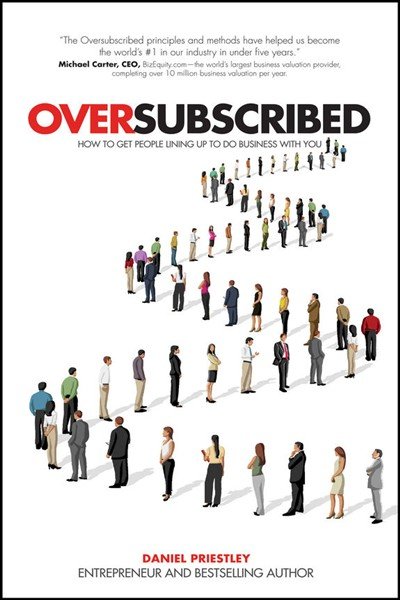
Most businesses chase clients desperately. The oversubscribed business flips this dynamic – they have more buyers than sellers, creating conditions where clients chase them. Daniel Priestley reveals the Campaign Driven Enterprise method: deliberately limit your capacity, signal your intentions before selling, build up demand through transparency and education, then release only when you have 5-10x more interest than capacity. This isn’t about getting lucky or being famous – it’s about engineering market imbalances through campaigns, knowing your real capacity, and being positively remarkable in everything you do.
⭐ The One Thing
Know your real capacity for delivering remarkable experiences and deliberately become oversubscribed at that level. Your price and profit are not determined by “the market” – they are determined by the specific supply-demand dynamics you create for your own offering. Markets go up because there are more buyers than sellers, and that’s it. Your job is to separate from “the market,” build “your market,” and systematically create more demand than you have capacity to supply through campaigns rather than always-on selling.
💭 First Impressions
The seven-hour rule validates content marketing – the brain can’t distinguish digital from real interaction, so 7 hours of content equals a relationship. The capacity concept is profound, as most businesses lie to themselves about how many clients they can actually delight. Transparency creates momentum – showing 350,000 people want 120,000 Glastonbury tickets makes people desperate to buy.
🔑 Key Concepts
-
The Oversubscribed Dynamic: Being oversubscribed is a specific state where demand exceeds supply – more people want your product or service than you have capacity to deliver. This creates three business states: (1) Oversubscribed = profits above normal wages, (2) Balanced = normal wages but no profit, (3) Undersubscribed = losses. The goal is deliberately engineering the first state through campaigns, signaling and transparency rather than hoping for it. This isn’t about being popular – it’s mathematics. If two people want your time and only one can get it, your price rises. Some people must miss out for oversubscription to work.
-
Capacity as Foundation: Capacity is not theoretical maximum production – it’s how many remarkable client relationships or epic product experiences you can deliver while leaving customers uplifted. Most businesses drastically overestimate their capacity. A London trainer named JP knew his real capacity was exactly 8 clients at £40,000 each. Glastonbury knows their capacity is 120,000 tickets. Knowing your real number is essential because you cannot become oversubscribed if you don’t know what your capacity is. Capacity determines everything: pricing, marketing intensity, team size and client selection.
-
Separating from “The Market”: “The market” is the general industry where most people compete. “Your market” is the specific tribe of people who highly value you and are willing to pay premium prices. 99% of Screen Actors Guild members can’t live on acting income, yet George Clooney commands millions per film. He’s not competing in “the market” – he’s created his own market with different economic rules. Your value is much higher than you think to a small number of people. You don’t need everyone to see you as in demand, only enough people in your market to drive your price up.
-
The Four Drivers of Market Imbalance: Only four ways exist to create more buyers than sellers: (1) Innovation – create something new only you sell, (2) Relationships – build connections so powerful buyers ignore competitors, (3) Convenience – reduce friction dramatically, (4) Price – invest in efficiencies allowing profit at lower prices. These drivers have opposites – you can’t be innovative AND convenient, or relationship-focused while being cheapest. You must choose your primary driver and excel at it. Major brands dominate one driver with secondary focus on another, never trying to win on all four.
-
Signaling and Transparency: Instead of asking people to buy immediately (binary yes/no), oversubscribed businesses signal intentions in advance and ask potential customers to signal interest back. Glastonbury requires pre-registration, signals when tickets are available, shows 350,000 registrations for 120,000 tickets, and creates an environment where tickets sell out in minutes – people buy without knowing which bands will perform. Transparency allows both parties to see interest building. This works at any scale: 13 people interested for 12 capacity starts oversubscription. 36 for 12 means 3x oversubscribed.
🧠 Mental Models & Frameworks
-
The Campaign Driven Enterprise (CDE) Five-Phase Method: Use this when running any business that wants to become oversubscribed. Phase 1 Planning – know capacity, identify who it’s for, create 12-month campaign schedule. Phase 2 Build-up – signal intentions, ask for signals back, educate and entertain, build transparency. Phase 3 Release – only release capacity when 5x for strong signals, 10x for educated customers, or 100x for soft interest. Phase 4 Delivery – exceed expectations, focus on Net Promoter Score, be positively remarkable. Phase 5 Celebrate and Innovate – tell stories, measure results, debrief, rest, then iterate. Block holidays first, then training (5-15% of income), then plan 3-4 campaigns per year with intense build-up periods followed by delivery and rest.
-
Fixed Volume Productivity: Use this when managing infinite to-do lists and competing demands. Keep two lists – “open” contains everything you might do (unlimited), “closed” has maximum 10 items. You cannot add to closed list until you complete something and create space. This caps work-in-progress and forces ruthless prioritization. Prevents efficiency trap where getting more done just generates more to do because demand will always expand to fill capacity you create.
-
The Seven-Hour Rule: Use this when building relationships at scale for big purchase decisions. Major purchasing decisions require about seven hours of interaction time before people feel comfortable buying. Can be accumulated through consuming content – blogs, videos, podcasts, books, events. Crucially, the human brain cannot distinguish between digital media and real-life interactions for relationship building. This explains why books are powerful business tools and why celebrity endorsements work (companies buy 7+ hour relationships celebrities already have with audiences).
-
The Three Business Games: Use this when deciding what size and type of business to build. Three games you can play – Struggle (clinging to past, repeating failures, stuck in fear), Lifestyle (3-4 enjoyable days weekly, small profitable team, healthy income, freedom), Performance (50+ hours weekly, 50+ person team, bold mission, big money and impact). Must master lifestyle before attempting performance. Not all businesses scale beyond lifestyle. Strategies that work for lifestyle don’t work for performance. Lifestyle might make you happier than performance. Goal is oversubscription at whichever level suits you, not necessarily bigness.
-
Products-for-Prospects vs. Core Offering: Use this when designing your product ecosystem. Need two types of products: Products-for-prospects are low-risk, low-cost offerings (books, workshops, reports, assessments) designed to educate and entertain for the requisite seven hours. Core offering is full, remarkable solution that’s profitable and represents main business. Generate many customers through products-for-prospects, then convert right ones into clients for core offering. Trying to sell only core offering without products-for-prospects makes becoming oversubscribed nearly impossible.
💬 My Favorite Quotes
Your value is much higher than you think to a small number of people. You don’t need everyone on the planet to see you as in demand; you only need enough people who can drive your price up.
Give away ideas. Charge for implementation.
If two people want your time and only one can get it, your price rises until one of them gives in. Your job isn’t to please everyone. Your job is to find those people who can’t live without you.
🙋 Who Should Read It?
-
Service professionals who feel undervalued and struggle to raise prices, small business owners stuck in feast-or-famine cycles, or entrepreneurs who hate “always-on” selling and want systematic demand generation through campaigns.
-
Consultants and coaches who give away expertise for free in discovery calls then struggle to convert, or product creators launching to crickets who can’t get anyone to pay attention despite building something great.
-
Anyone who competes mainly on price and wants to escape commoditization, or solo practitioners dreaming of lifestyle businesses with great income while working 3-4 days per week.
🔗 Additional Resources
People and Businesses Referenced:
- Jamie Oliver (ecosystem value creation)
- Gary Vaynerchuk (auction story, 7-hour relationships)
- Pete Evans (philosophy and polarization)
- Glastonbury Festival (transparency and signaling)
- Bremont watches (storytelling)
Concepts Explored:
- Campaign Driven Enterprise (CDE) methodology
- Parkinson’s Law (work expands to fill time)
- Net Promoter Score (measure of delivery excellence)
- Key Person of Influence framework (Priestley’s other work)
Related Books and Authors:
- Seth Godin (Purple Cow, Tribes)
- Ryan Holiday (Perennial Seller, pre-launch strategies)
- Russell Brunson (funnels and campaign structures)
- Robert Cialdini (Influence, scarcity and social proof)