⚡ The Lightning Summary
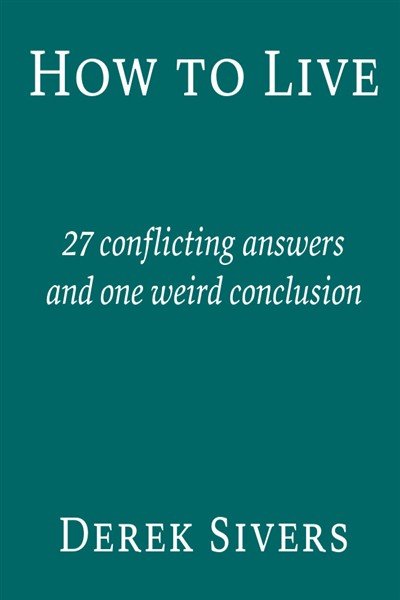
How to Live presents 27 completely contradictory philosophies for living well, each valid, each incompatible with the others. Derek Sivers doesn’t tell you which way is right. Instead, he demonstrates that all advice is contextual and personal. Like conducting an orchestra, you don’t choose one instrument—you bring different ones forward at different times. This is a book about freedom from dogma and the recognition that there is no single right answer to how you should live.
⭐ The One Thing
The one thing this book taught me: All life advice is contextual, and that’s liberating. There is no universal “right way” to live. You are the composer and conductor of your life, orchestrating 27 different valid philosophies based on your current situation, personality and life stage. The contradictions aren’t a bug—they’re the feature that forces you to think for yourself rather than blindly follow any single path.
💭 First Impressions
The sheer audacity of presenting contradictory advice with equal conviction landed hard. Each chapter feels complete and compelling, then the next completely contradicts it. Reading opposing philosophies back-to-back didn’t create confusion—it created clarity. The contradictions forced me to think about context and nuance. Every time I started to think “this is the right way,” the next chapter would completely undermine it, forcing me to question my assumptions. The experience was liberating.
🔑 Key Concepts
-
The Orchestra Metaphor: You are the composer and conductor of your life. These 27 philosophies are instruments you can emphasize at different times. You don’t choose one—you orchestrate all of them based on context, bringing different ones forward when needed.
-
Epistemic Humility: No single perspective captures the full truth about how to live. Anyone offering one universal way is thinking too narrowly or selling something. Wisdom lies in recognizing that multiple contradictory truths can coexist.
-
Context is Everything: The “right” advice depends entirely on your current situation, personality, values and life stage. What works for you at 25 may be completely wrong at 45. What works for an extrovert may be terrible for an introvert.
-
Intentionality Over Drift: Whether you choose to commit or stay flexible, act or refrain from action, the critical element is conscious choice. All 27 philosophies demand you make deliberate decisions rather than drift through life on autopilot.
-
Integration Over Selection: The goal isn’t to pick one philosophy and reject the others. It’s to understand all perspectives and integrate insights from many. You can be independent AND connected, present-focused AND future-oriented, stable AND changing—at different times or in different domains.
🧠 Mental Models & Frameworks
-
The Balanced Wheel Framework: Use this when evaluating if your life is lopsided. Imagine life aspects as spokes in a wheel (health, relationships, career, learning, creativity, etc.). A lopsided wheel wobbles. Check which spokes are too long or too short and adjust. Work more on weaknesses than strengths to create balance. Apply this as a monthly check-in on different life domains to identify neglected areas before they become crises.
-
The Duck-Rabbit Perspective: Use this when facing seemingly contradictory advice or options. Like the optical illusion that’s both duck and rabbit, contradictory truths can both be valid. Don’t ask “which is right?” Ask “when is each right?” Hold multiple perspectives simultaneously without needing to reconcile them. When experts disagree or you face opposing good advice, recognize both can be true in different contexts.
-
The Dependency Analysis: Use this when assessing freedom and vulnerability. Map all dependencies—income sources, relationships, technologies, habits. Each dependency is both a connection and a vulnerability. Too many dependencies create fragility; too few create isolation. Consciously choose which dependencies serve you. Periodically audit what you depend on and diversify critical dependencies while strengthening valuable ones.
-
The Present-Future Spectrum: Use this when making decisions about time orientation. Every decision falls somewhere between “optimize for now” and “optimize for future.” Neither extreme is universally right. Present-focused decisions maximize immediate experience; future-focused decisions compound over time. For each major decision, explicitly identify whether you’re optimizing for present joy or future benefit, and verify that matches your actual priorities.
-
The Action-Inaction Filter: Use this when deciding whether to intervene or let things be. Most problems come from unnecessary action. Most progress comes from necessary action. Before acting, ask: “What happens if I do nothing?” Often inaction is wiser. When action is needed, make it count. Default to waiting 24 hours before responding to provocative situations—most “urgent” things resolve themselves or look different with time.
💬 My Favorite Quotes
All misery comes from dependency. If you weren’t dependent on income, people or technology, you would be truly free. The only way to be deeply happy is to break all dependencies.
The easy road leads to a hard future. The hard road leads to an easy future.
If you’re not embarrassed by what you thought last year, you need to learn more and faster.
🙋 Who Should Read It?
-
People paralyzed by contradictory advice who feel overwhelmed by conflicting self-help books, gurus and life philosophies—this book gives you permission to recognize that multiple truths can coexist.
-
Those in life transition moments—career changes, relationship shifts, relocations—when old approaches no longer work and you need fresh perspectives on how to live differently.
-
Recovering dogmatists who’ve left rigid belief systems (religious, political, ideological) and need a framework for holding multiple perspectives without new dogma.
🔗 Additional Resources
Related Books:
- “Meditations” by Marcus Aurelius (Stoic philosophy, prepare for worst)
- “The Art of Learning” by Josh Waitzkin (mastery philosophy)
- “Antifragile” by Nassim Taleb (gaining from disorder, pursue pain)
- “The Paradox of Choice” by Barry Schwartz (commitment vs. options)
Philosophical Traditions:
- Stoicism (prepare for worst, control what you can)
- Taoism (do nothing, wu wei principle)
- Existentialism (create yourself, radical freedom)
- Buddhism (non-attachment, present moment)
Derek Sivers’ Other Work:
- “Anything You Want” (entrepreneurship, unconventional business)
- “Hell Yeah or No” (decision-making, commitment)
- sivers.org (blog with directives and philosophy)