
⚡ The Lightning Summary
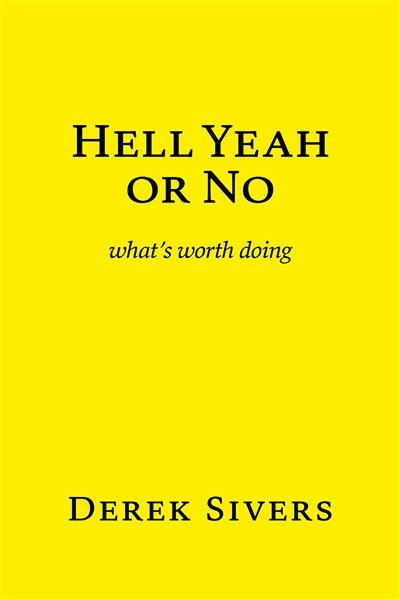
A collection of life philosophy essays on making better decisions, fixing faulty thinking, and taking meaningful action. Derek Sivers shares counter-intuitive insights on when to say no, how to change perspective, and why our actions reveal more than our words ever could.
⭐ The One Thing
The one thing this book taught me: Your actions, not your words or intentions, reveal what you actually value and want in life. Stop lying to yourself about your priorities and let your behavior show you the truth.
💭 First Impressions
Some essays contradicted each other (saying yes vs saying no) which felt confusing at first but actually reflects the nuance of when different strategies apply. The counter-melody metaphor helped me understand why some advice felt contrarian—it’s meant to balance the mainstream narrative. Derek’s willingness to share personal failures and evolving beliefs made the advice feel more trustworthy than typical self-help.
🔑 Key Concepts
-
Hell Yeah or No: The central decision-making filter that says if you’re not feeling “Hell yeah, that would be awesome!” about something, say no. This creates space in your life for the opportunities that truly excite you and allows you to give them your full attention when they arrive. The key is knowing when to apply this—it’s crucial when you’re overwhelmed and over-committed, but counterproductive when you’re starting out and need variety.
-
Actions Reveal Real Values: What you actually do, not what you say you want, reveals your true priorities. If you’ve been talking about starting something for years but haven’t launched it, you don’t really want to do it. This concept forces brutal honesty about where you’re spending your time and energy. The remedy is either admitting your real priorities or immediately starting to do what you claim to want to do.
-
Present-Focused vs Future-Focused: Everyone falls somewhere on a spectrum between living for today and using today as a stepping stone for tomorrow. Present-focused people pursue pleasure and immersion but may lack discipline for achievement. Future-focused people delay gratification and build careers but may struggle with relationships and enjoying life. Both mindsets are necessary—you need present-focus to enjoy life but also future-focus for deeper fulfillment through achievement.
-
Local vs Global Focus: You can focus your time and energy locally (your community, in-person relationships) or globally (creating for the whole world online). Neither is right or wrong, but there’s a real trade-off. When you’re local-focused, you may serve your community but aren’t being as useful to the rest of the world. Understanding this helps you make conscious choices about where to invest your energy.
-
The Resistance and Turning Pro: Based on Steven Pressfield’s work, this is the internal force that keeps you from doing your most important creative work. The solution is creating a situation with no escape—deciding in advance that the answer to all future distractions is “no” until you finish what you started. It’s making one decision that eliminates all future decisions until the work is done.
🧠 Mental Models & Frameworks
-
Bronze Medal Thinking: Use this when experiencing envy, resentment, or dissatisfaction. Instead of comparing up to the next-higher situation (like a silver medalist focused on gold), compare down to the next-lower one (like a bronze medalist grateful to have medaled at all). Shifting from “I almost had more” to “I could have had nothing” changes your emotional state immediately and restores gratitude while maintaining healthy ambition for specific skills.
-
Tilting the Mirror: Use this when external pressures are affecting your motivation. Identify what’s causing subtle stress and remove it from your awareness, like tilting a rearview mirror up so you can’t see impatient drivers behind you. This applies to social media notifications, email badges, and other environmental triggers that create pressure. The physical metaphor reminds you that you can control what you allow into your field of vision.
-
Overcompensate to Compensate: Use this when trying to change a deeply ingrained habit or mindset. Go all the way to the opposite extreme to counterbalance a lifetime of conditioning, cultural baggage, and environmental pressure. If you’ve been too risk-averse, seek scary opportunities aggressively. What feels like overcompensation is actually just balancing against invisible weight on the other side.
-
The Pedestrian Walkway Principle: Use this when making long-term plans or business decisions. Wait to make permanent decisions until you have the most information, as late as possible. Let actual behavior create the path, then pave it. Apply this to product development and life planning—start projects without naming them, build systems only after proving demand, and resist the urge to figure everything out in advance.
-
Echolocation Advice-Seeking: Use this when seeking guidance on important decisions. Bounce ideas off many different people and listen to all the echoes to get the whole picture, rather than taking any one person’s advice too seriously. Remember that their advice is colored by their context. No single source has the full picture, but the pattern across many sources reveals truth.
💬 My Favorite Quotes
If they really wanted to do it, they would have done it. No matter what you say, your actions reveal the truth.
The standard pace is for chumps. If you’re more driven than most people, you can do way more than anyone expects.
I actually love being wrong, even though it cracks my confidence, because that’s the only time I learn. I actually love being lost, even though it fuels fears, because that’s when I go somewhere unexpected.
🙋 Who Should Read It?
-
Entrepreneurs and creatives who are overwhelmed by opportunities and can’t figure out what to say yes to anymore—if you’re successful enough that you’re drowning in offers but not fulfilled, this book will help you reclaim your focus.
-
People in their late twenties to forties experiencing the “is this all there is?” feeling despite doing what they’re supposed to do—if you’re following a script that doesn’t feel right, these essays will challenge your assumptions.
-
Anyone stuck between multiple life paths who feels they need to choose just one direction—if you’re paralyzed by the donkey problem, this book offers a long-term perspective on doing everything sequentially.
🔗 Additional Resources
Books Cited or Referenced:
- “Anything You Want” by Derek Sivers (his first book about starting and selling CD Baby)
- “The Time Paradox” by Phil Zimbardo (on present vs future time orientation)
- “Turning Pro” by Steven Pressfield (on overcoming creative resistance)
- “The War of Art” by Steven Pressfield (on creative struggle)
- “Positioning” by Al Ries and Jack Trout (business book applied to music)
Related Thinkers:
- Steven Pressfield (creative resistance)
- Kimo Williams (Derek’s music teacher who taught “no speed limit”)
- Abraham Maslow (choosing growth over safety)
Complementary Frameworks:
- Flow state psychology by Mihaly Csikszentmihalyi
- Musical counterpoint and counter-melody concepts
- Human echolocation as metaphor for advice-seeking