
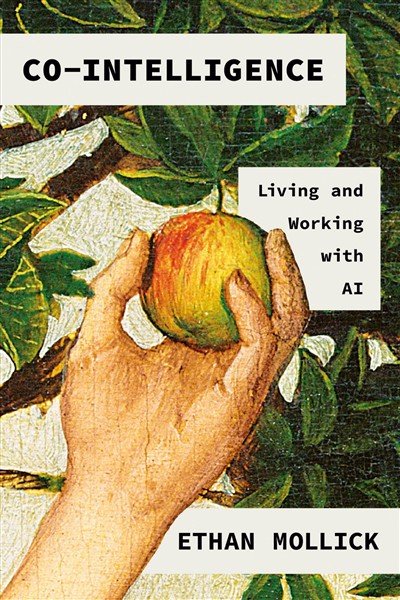
⚡ The Lightning Summary
AI has arrived as a co-intelligence that can augment human capabilities across nearly every domain of work and life, delivering 20-80% productivity improvements. Rather than waiting for perfect understanding or regulation, we must engage with AI now through deliberate experimentation, maintaining human judgment while leveraging AI’s alien intelligence to enhance creativity, productivity and learning. The future isn’t about humans versus machines, but humans with machines creating outcomes neither could achieve alone.
⭐ The One Thing
The one thing this book taught me: Always invite AI to the table, but never leave the table yourself. AI works best as a collaborative partner where humans maintain ultimate responsibility and judgment while AI provides speed, scale and novel perspectives that amplify human capabilities in ways we’re only beginning to understand.
💭 First Impressions
The concept of AI as fundamentally “alien” yet trained on human culture creates a fascinating paradox, with the Jagged Frontier metaphor brilliantly explaining inconsistent performance. Mollick’s position as a non-computer scientist studying innovation provides a unique practitioner’s perspective that’s surprisingly practical and immediately actionable despite the rapidly evolving technology. The “three sleepless nights” framing captures the genuine existential weight, while the Centaur vs. Cyborg distinction and honest treatment of both catastrophic and utopian scenarios feel more balanced than most AI discourse.
🔑 Key Concepts
-
The Four Principles of Co-Intelligence: Always invite AI to the table (experiment with AI across all work), be the human in the loop (maintain judgment and responsibility), treat AI like a person but tell it what kind of person it is (define personas for better outputs), and assume this is the worst AI you will ever use (current limitations are temporary).
-
Centaurs and Cyborgs: Two models for human-AI collaboration. Centaur approach maintains clear division of labor with strategic task delegation. Cyborg approach integrates deeply, moving back and forth between human and AI contributions within tasks.
-
The Falling Asleep at the Wheel Effect: When AI quality is very high, humans become complacent, stop paying attention and lose skills. Paradoxically, lower-quality AI that requires human correction produces better long-term outcomes because it keeps humans engaged.
-
The Jagged Frontier: AI capabilities are inconsistent and unpredictable. Performance ranges from middle-school to PhD level depending on the task, with no reliable way to predict beforehand where it will excel or fail.
-
The Four Scenarios Framework: Four distinct futures for AI—As Good as It Gets (plateaus soon), Slow Growth (steady improvement), Exponential Growth (massive acceleration) and The Machine God (AGI/superintelligence). Each requires different preparation strategies.
🧠 Mental Models & Frameworks
-
The Turing Test as Imitation Game: Use this when evaluating whether AI behavior matters more than AI sentience. Focus on AI’s practical capabilities and outputs rather than getting caught up in philosophical questions about consciousness or “real” intelligence. If AI can perform the task convincingly, the question of whether it “understands” becomes less relevant for practical purposes.
-
Amara’s Law for AI Adoption: Use this when planning for AI’s impact on your career or organization. We tend to overestimate the effect of a technology in the short run and underestimate the effect in the long run. Don’t panic about immediate job loss, but do invest seriously in understanding AI capabilities now to prepare for compounding long-term changes.
-
The Falling Asleep at the Wheel Effect: Use this when deciding how much to rely on AI for important tasks. When AI quality is very high, humans become complacent and lose skills. Deliberately use AI for tasks where you can check its work rather than blindly accepting outputs, especially when learning new skills.
-
Personas as Prompting Strategy: Use this any time you need AI to perform a specific type of task. Define who the AI “is” before asking it to do something—”You are an expert marketing strategist” produces different outputs than “You are a witty comedian.” Always start AI conversations by defining the expert role, personality and approach you need.
-
The Four Scenarios Framework: Use this when thinking about AI’s future impact on society and your planning horizon. The four futures (As Good as It Gets, Slow Growth, Exponential Growth, The Machine God) each require different preparation strategies. Prepare for Scenario 2, hope for local eucatastrophes, and stay informed enough to recognize if we’re shifting toward Scenario 3 or 4.
💬 My Favorite Quotes
The concept of ‘human in the loop’ has its roots in the early days of computing and automation. It refers to the importance of incorporating human judgment and expertise in the operation of complex systems.
Remember that LLMs work by predicting the next word, or part of a word, that would come after your prompt.
Amara’s Law: ‘We tend to overestimate the effect of a technology in the short run and underestimate the effect in the long run.’
🙋 Who Should Read It?
-
Knowledge workers feeling AI anxiety who are writers, marketers, consultants or teachers worried that AI will make them obsolete—this provides the roadmap for collaboration rather than competition and helps integrate AI without losing your value or becoming dependent.
-
Managers implementing AI in organizations who are responsible for helping teams adopt AI tools and need frameworks to avoid both the “falling asleep at the wheel” problem (over-reliance destroying skills) and the paralyzing fear that prevents experimentation entirely.
-
Educators and students navigating AI in learning who are teachers facing the reality that traditional assessments no longer work, or students wondering how to learn in the AI age, and need concrete strategies for redesigning education that leverages AI rather than fighting it.
🔗 Additional Resources
Key Research and Studies:
- Benjamin Bloom’s “The 2 Sigma Problem” (1984) on one-to-one tutoring effectiveness
- Fabrizio Dell’Acqua’s research on AI and recruiter performance
- Bloomberg study on Stable Diffusion amplifying stereotypes
Related Thinkers and Experts:
- Alan Turing and “Computing Machinery and Intelligence” (1950)
- John von Neumann on the Singularity concept
- Roy Amara and Amara’s Law on technology adoption
Complementary Books and Frameworks:
- The Turing Test and imitation games
- J.R.R. Tolkien’s concept of “eucatastrophe”
- Moore’s Law on exponential technological growth