
⚡ The Lightning Summary
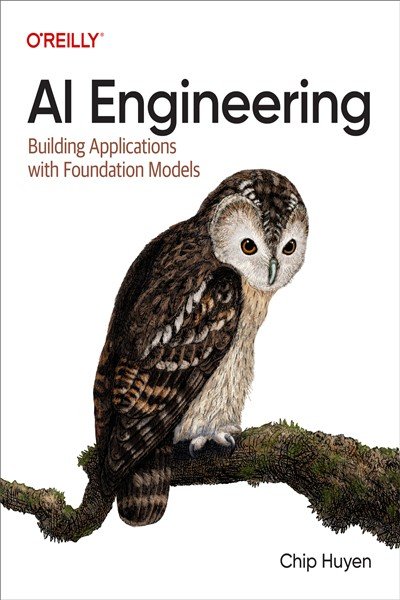
AI Engineering is the definitive guide to building production-ready applications with foundation models. It covers the complete lifecycle, from understanding model fundamentals and establishing evaluation pipelines to implementing prompt engineering, RAG, finetuning and inference optimization. The book emphasizes fundamentals over tools, evaluation-first development and systematic approaches to adapting powerful pre-trained models for real-world problems. Written by Chip Huyen, it synthesizes insights from 100+ conversations with researchers, framework developers and practitioners.
⭐ The One Thing
The one thing this book taught me: Evaluation is the foundation of successful AI engineering. Before writing a single line of code, define your success metrics. Without reliable evaluation pipelines, you cannot systematically improve your application, compare approaches, or confidently deploy to production. Evaluation-driven development unlocks everything else: better prompts, smarter context construction, informed finetuning decisions and continuous improvement through data flywheels.
💭 First Impressions
What struck me most was how AI Engineering as a discipline has been transformed by model-as-a-service. Anyone can now build AI applications by adapting powerful pre-trained foundation models through prompting, context construction and selective finetuning, democratizing AI development while creating new challenges in evaluation, safety and system design. The insight that context construction for foundation models is equivalent to feature engineering in classical ML completely reframed how I think about RAG systems. The biggest takeaway is that the bottleneck to AI adoption isn’t model capabilities but evaluation, and successful applications define criteria before building anything.
🔑 Key Concepts
-
The Three-Layer AI Stack: Understanding where your work fits in the ecosystem and what skills are needed. Application Development (prompts, context, interfaces, evaluation), Model Development (training, finetuning, data engineering) and Infrastructure (serving, compute, monitoring). Each layer requires different expertise and tools, and most application builders work primarily in the first layer but benefit from understanding the others.
-
Context Construction as Feature Engineering: For foundation models, constructing the right context (what information the model sees) is equivalent to feature engineering in classical ML. Both serve the same purpose: giving the model necessary information to process inputs effectively. RAG systems excel at this by retrieving relevant information, while agentic patterns add planning and tool use for complex tasks.
-
Evaluation-Driven Development: The biggest bottleneck to AI adoption is evaluation, not model capabilities. Successful applications define evaluation criteria before building anything, combine multiple evaluation approaches to mitigate biases (LLM-as-judge, human review, functional correctness) and build reliable pipelines that enable systematic improvement and confident deployment.
-
Start Simple, Add Complexity: Begin with basic model API calls, add prompt engineering, implement caching if needed, add RAG for knowledge gaps, include guardrails for safety, implement routing for efficiency, consider finetuning only after exhausting other approaches. Each component adds capability but also complexity and failure modes.
-
The Golden Data Trio: Quality (accuracy, consistency, unbiased), Coverage (diverse representation of use cases) and Quantity (sufficient scale for generalization). All three matter, so optimize for balance rather than just one dimension. Small, high-quality datasets with good coverage outperform large, noisy datasets.
🧠 Mental Models & Frameworks
-
Evaluation Method Triangulation: No perfect evaluation method exists. Combine multiple approaches: LLM-as-judge for scale, human evaluation for gold standard calibration, functional correctness where applicable and similarity metrics for specific tasks. Each method has biases, and combination mitigates limitations. Never rely on a single evaluation metric.
-
The Latency-Throughput-Cost Triangle: Three interconnected metrics where optimizing one often degrades another. Reducing cost typically increases latency. Reducing latency often increases cost. Maximizing throughput may increase per-query latency. Define which metric matters most for your use case before optimizing. Chatbots need low latency, batch processing needs high throughput and internal tools may prioritize cost reduction.
-
The Data Flywheel: User feedback flows into improved models, which create better user experience, leading to more usage, generating more feedback, enabling continuous improvement. This requires product, engineering and data science collaboration.
-
Internal Goal Transformation: Transform external goals (winning, getting promoted, being liked) into internal goals (playing your best, doing excellent work, being kind). You control the latter completely, eliminating disappointment over uncontrollable outcomes.
-
Finetuning Decision Framework: Exhaust prompt engineering and RAG before finetuning since they’re faster, cheaper and easier to iterate. Use finetuning when prompt engineering plateaus, you need consistent output format, you want to reduce latency with smaller models, or you need to handle domain-specific vocabulary. Watch for catastrophic forgetting and validate on diverse tasks.
💬 My Favorite Quotes
Evaluation is the biggest bottleneck to AI adoption. Being able to build reliable evaluation pipelines will unlock many new applications.
Many AI challenges are, at their core, system problems. To solve them, it’s often necessary to step back and consider the system as a whole. A single problem might be addressed by different components working independently, or a solution could require the collaboration of multiple components.
Tools become outdated quickly, but fundamentals should last longer.
🙋 Who Should Read It?
-
AI engineers and ML engineers moving from traditional ML to foundation model-based applications, struggling to understand how prompt engineering, RAG and finetuning fit together, or facing challenges with evaluation, latency or costs in production systems.
-
Technical leaders and engineering managers who need to build or scale AI teams, understand the AI engineering stack to make informed architectural decisions, or evaluate whether to build, buy or use APIs for AI capabilities.
-
Anyone building AI applications who has moved beyond demos and prototypes but struggles with systematic evaluation, production readiness, managing costs or ensuring consistent quality.
🔗 Additional Resources
Related Books:
- “Designing Machine Learning Systems” by Chip Huyen (companion book covering traditional ML engineering)
- “Deep Learning” by Goodfellow, Bengio, Courville (theoretical foundations)
- “Hands-On Machine Learning with Scikit-Learn, Keras & TensorFlow” by Aurélien Géron
Key Research Papers:
- “Attention Is All You Need” (2017) – Transformer architecture foundation
- “Language Models are Few-Shot Learners” (2020) – GPT-3 paper
- “Retrieval-Augmented Generation for Knowledge-Intensive NLP Tasks” (2020)
- “Chain-of-Thought Prompting Elicits Reasoning in Large Language Models” (2022)
- “LoRA: Low-Rank Adaptation of Large Language Models” (2021)
Community Resources:
- GitHub repository: github.com/chiphuyen/aie-book
- Chip Huyen’s blog: huyenchip.com/blog