
⚡ The Lightning Summary
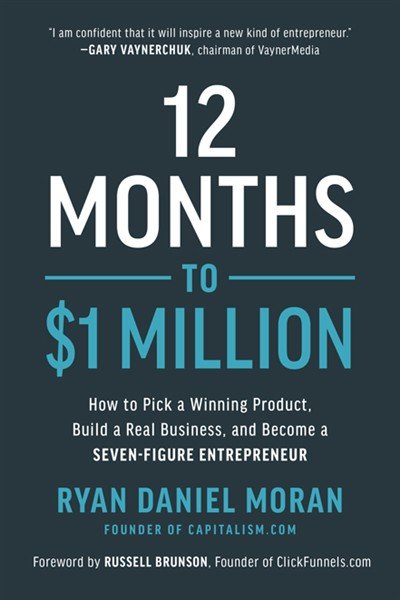
A comprehensive blueprint for building a seven-figure e-commerce business in twelve months through a proven formula: 3-5 products at $30 each, selling 25-30 units per day. Ryan Daniel Moran shares his journey to a $10 million exit and provides a step-by-step framework focused on serving a specific customer, building audience before launch, and creating compounding momentum through strategic product rollouts on platforms like Amazon.
⭐ The One Thing
The one thing this book taught me: Build a brand by serving a specific person, not selling products to demographics. When you focus on creating value for a clearly defined customer and their journey, the products, sales and eventual exit naturally follow. It’s people first, products second.
💭 First Impressions
What immediately grabbed my attention was how achievable Ryan made this formula feel. The math is simple (3-5 products × 25 sales/day × $30 = $1M), but what sold me was his honesty about the psychological reality of entrepreneurship. His candid discussion about post-exit depression and the emotional toll of building a business added a rare depth that made me trust him more than the typical “rah-rah” business guru. The dozens of student success stories combined with the emphasis on small, engaged audiences over massive followings created genuine belief and challenged everything I thought I knew about scaling.
🔑 Key Concepts
-
The Million-Dollar Formula: If you have 3-5 products at an average price of $30 each, selling 25-30 units per day, you have a million-dollar business. This simple math makes the goal concrete and achievable.
-
Identity Marketing: People don’t buy products, they buy brands that reflect who they are. Target a specific identity or tribe, not demographics. Black Rifle Coffee targets conservative gun owners who happen to drink coffee, not coffee drinkers.
-
Stacking the Deck: Build your audience 6-8 weeks before product launch through content creation, documenting your journey, and cultivating relationships with micro-influencers. Launch with momentum, not from zero.
-
The Gateway Product Concept: Your first product should solve an immediate pain point while naturally leading customers to products 2-5. Think customer journey, not one-off sales.
-
The Three Stages Timeline: Month 1-4 is The Grind (decision-making, launching, reaching 25 sales/day), Month 5-9 is The Growth (rolling out products 2-5), Month 10-12 is The Gold (scaling to $100k/month).
🧠 Mental Models & Frameworks
-
The Hot List Formula: 1,000 followers + 10 personal contacts + 1 micro-influencer = 100 sales on launch day, creating the momentum needed for marketplace algorithms. Any product launch needs a warm audience, not cold traffic.
-
The Snowball Effect: Each new product doesn’t just add revenue, it multiplies existing product sales through cross-promotion, bundles, and algorithm rewards for momentum. Product 2 is more valuable than it appears because it boosts Product 1.
-
ROI Arbitrage: Good debt produces returns greater than its cost. Borrowing at 20% to buy inventory that returns 500% is smart business. The key is distinguishing between debt that builds assets vs. debt that merely spends.
-
Customer Lifetime Value (LTV) Focus: Be willing to lose money acquiring customers if their lifetime value justifies it. Joel Marion spent $25 to acquire customers worth $30+ after 90 days, scaling to $100M year one. Outspending competitors on acquisition is a competitive advantage if you win the long game.
-
Value Creation vs. Value Extraction: Stop asking “How do I get my slice?” and start asking “What new pie can I bake?” Scarcity thinking leads to competition. Abundance thinking creates new markets and shifts you from taking market share to creating new value.
💬 My Favorite Quotes
An entrepreneur is someone who takes responsibility for a problem and does something about it.
If you are not embarrassed by the first iteration of your product, then you aren’t moving fast enough.
Happiness is found in your relationships, how you spend your time, and the small things that you enjoy. Money expands your menu of options.
🙋 Who Should Read It?
-
Aspiring entrepreneurs who want to start an e-commerce business but feel overwhelmed by where to begin and need a specific, proven roadmap
-
Small business owners doing $50k-$500k annually who want to scale to seven figures but lack a systematic growth strategy
-
Failed entrepreneurs who’ve launched products that fizzled, ready to understand why audience-building before launch is critical
🔗 Additional Resources
Books Referenced:
- “Rich Dad Poor Dad” by Robert Kiyosaki – Financial education and assets
- “The 4-Hour Work Week” by Tim Ferriss – Lifestyle design and entrepreneurship
- “Crush It!” by Gary Vaynerchuk – Personal branding and social media
Companies and Case Studies:
- Dollar Shave Club – Started with $100k, sold to Unilever for $1 billion
- Native Deodorant – Started with $500, sold to P&G for $100 million in 18 months
- Quest Nutrition – $500M in sales by year 4, sold for $1 billion
- BioTrust – Joel Marion’s supplement company, $100M revenue in year one
- Primal Kitchen – Sold to Heinz for $200 million in 4 years
- Onnit – Aubrey Marcus’s performance company, $100M+ valuation
- Bulletproof Coffee – Dave Asprey’s biohacking empire
- Black Rifle Coffee – Example of identity marketing
- Poo-Pourri – $400+ million in sales
- RXBAR, Casamigos Tequila – Additional exit examples
Platforms and Tools:
- Alibaba.com – Product sourcing
- Amazon – Primary sales channel
- Kickstarter – Crowdfunding for validation and capital
- Facebook/Instagram – Audience building
- ClickFunnels – Russell Brunson’s sales funnel platform
People and Influencers:
- Russell Brunson – Wrote foreword, ClickFunnels founder
- Tim Ferriss – Lifestyle design, entrepreneurship
- Joel Marion – BioTrust co-founder, customer acquisition strategy
- Aubrey Marcus – Onnit founder, human performance
- Gary Vaynerchuk – Personal branding and hustle culture
Related Frameworks:
- Diffusion Theory of Marketing – Innovators to early adopters to masses
- The Lean Startup methodology – MVP and iteration
- Blue Ocean Strategy – Creating new markets vs. competing in red oceans