
⚡ The Lightning Summary
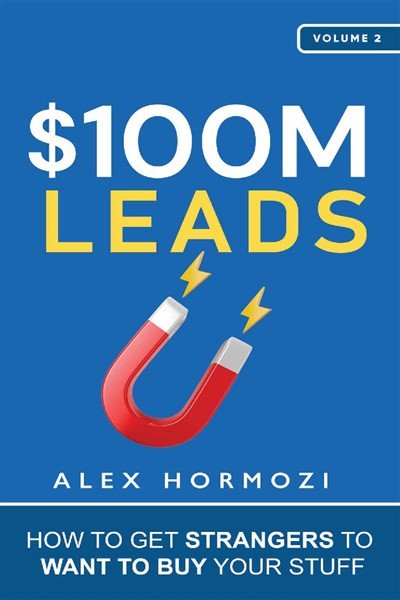
Most businesses fail not because they have a bad product, but because they don’t know how to get enough customers. Hormozi reveals his framework for generating unlimited leads through four core methods: Warm Outreach, Cold Outreach, Free Content and Paid Ads. By mastering the “Core Four” and understanding the Leads Equation (getting more people to know you exist × increasing desire for your stuff), you can create a predictable, scalable customer acquisition engine that never runs dry.
⭐ The One Thing
The one thing this book taught me: Lead generation is a volume game wrapped in a skill game. You don’t need one perfect channel. You need to run all four channels (warm, cold, content, ads) simultaneously at the highest volume possible while continuously improving your skills. The person who consistently does the most outreach with the best messaging wins.
💭 First Impressions
What grabbed me immediately was how refreshingly tactical this book is. Rather than vague marketing theory, Hormozi delivers an actual playbook with the “Core Four” framework that simplifies an overwhelming landscape of options into something manageable. His transparency about failures (spending over $1M learning to run ads) and his relentless emphasis on volume make the lessons feel credible and actionable. The CTA framework and Leads Formula tie everything together mathematically, transforming lead generation from mysterious art into a repeatable system you can actually execute.
🔑 Key Concepts
-
The Core Four: The only four ways to let people know you exist. 1) Warm Outreach (people you know), 2) Cold Outreach (people you don’t know), 3) Free Content (posting stuff), 4) Paid Ads (running ads). Every other marketing tactic is a subcategory of these four. Mastering all four creates an unstoppable lead generation machine that can’t be killed by algorithm changes, platform bans or market shifts.
-
The Leads Equation: Leads = Quantity × Quality. Quantity = How many people you reach. Quality = How good your messaging is. To 10x your leads, either 10x your quantity, 10x your quality or some combination. Most beginners need to focus on quantity (doing more). Most intermediates need to focus on quality (getting better). Masters do both simultaneously at scale.
-
Advertising Awareness: The six levels of customer awareness that determine your messaging strategy. 1) Unaware (don’t know problem exists), 2) Problem Aware (know problem, don’t know solutions exist), 3) Solution Aware (know solutions exist, don’t know about your solution), 4) Product Aware (know your product exists, haven’t purchased), 5) Most Aware (customers who bought), 6) Loyalists (customers who buy repeatedly). Your messaging must match their awareness level or it will fail.
-
The CTA Framework: The four types of Calls To Action that drive all business actions. 1) Give (free value), 2) Ask (request information/small commitment), 3) Close (make an offer), 4) Ascend (upsell/cross-sell). Most businesses over-ask and under-give. The magic ratio for content is 5:1 (five “gives” for every one “ask”). Master giving value first, and closes become effortless.
-
Engagement Loops: The compound interest of marketing. Every piece of content should generate engagement (likes, comments, shares), which increases distribution, which creates more engagement, creating an upward spiral. Comments are the most valuable engagement because they signal to algorithms that your content is interesting, multiplying your organic reach for free.
🧠 Mental Models & Frameworks
-
The 1-10-100 Rule: To get 1 customer, you need approximately 10 qualified leads. To get 10 qualified leads, you need 100 people to engage with your content or outreach. To get 100 engagements, you need 1,000-10,000 people to see your message depending on conversion rates. Work backwards from your revenue goal to determine how much volume you need.
-
The Give-Give-Give-Ask Pattern: Provide value three times before making any ask. This builds trust, demonstrates expertise and creates reciprocity. When you finally ask, people are primed to say yes. For every sales post, create 3-5 value posts. For every cold email that asks for a meeting, send 3-4 emails that give value first without asking for anything.
-
The CLOSER Framework: A structure for writing any marketing message or sales script. C (Call out and grab attention by calling out your avatar), L (Label their problem), O (Overview what’s possible), S (Sell your pitch), E (Explain away objections), R (Reinforce the offer and create urgency). This structure ensures every critical element is included in your copy.
-
The Engagement Ladder: Move people up the engagement ladder: 1) See your content (awareness), 2) Like/react (micro-engagement), 3) Comment (active engagement), 4) Share (advocacy), 5) DM you (high intent), 6) Book call (qualified lead), 7) Buy (customer). Each step increases commitment and filters for higher-quality prospects. Design content specifically to move people up each rung rather than jumping from awareness to sale.
-
The Testing Threshold: You haven’t truly “tested” a channel until you’ve done enough volume to reach statistical significance. For ads: $1,000+ spend and 100+ conversions. For cold outreach: 1,000+ contacts minimum. For content: 100+ posts. Most people quit before reaching the testing threshold and wrongly conclude “it doesn’t work.”
💬 My Favorite Quotes
Advertising is the tax you pay for being unremarkable.
Content is the rent you pay to exist on the internet.
Most people quit before reaching the testing threshold and wrongly conclude ‘it doesn’t work’ when they simply didn’t do enough volume.
🙋 Who Should Read It?
-
Entrepreneurs doing under $10M/year who are inconsistent with lead generation, rely too heavily on one channel (referrals or word-of-mouth) and panic when it dries up.
-
Business owners who’ve “tried” marketing channels but gave up too soon without reaching the testing threshold (1,000+ contacts for cold outreach, 100+ posts for content, $1,000+ for ads).
-
Anyone who read $100M Offers and created a great offer but doesn’t know how to get it in front of enough people and wants to build predictable customer acquisition from day one.
🔗 Additional Resources
Books Referenced:
- “Breakthrough Advertising” by Eugene Schwartz (the source of advertising awareness levels)
- “DotCom Secrets” and “Traffic Secrets” by Russell Brunson
- Multiple books on content marketing and social media by Gary Vaynerchuk
- Books on direct response marketing by Dan Kennedy
Related Frameworks:
- The AIDA model (Attention, Interest, Desire, Action)
- The Customer Value Journey (traffic → conversion → monetization)
- The Hook, Story, Offer framework
- Content marketing flywheel
Hormozi’s Other Resources:
- Acquisition.com – Free training materials
- “$100M Offers” – Creating irresistible offers
- “$100M Money Models” – Business model design