
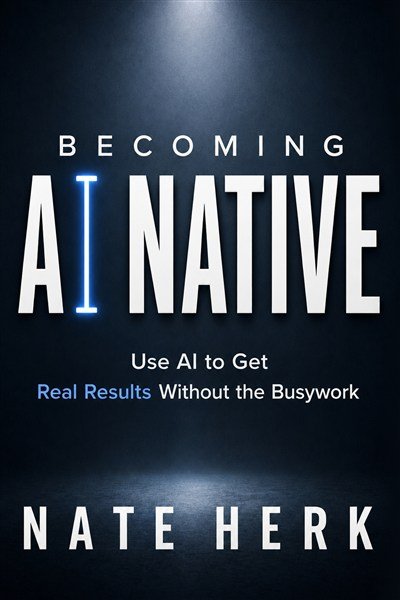
⚡ The Lightning Summary
The rules of productivity flipped: personal output no longer predicts career success, the ability to hand work off to AI does. The book teaches a three-part method, Mindset (how to think about your work), Method (how to decide what to automate) and Machine (how to build and operate it safely), for finding the right tasks to hand off and doing it without anything breaking.
⭐ The One Thing
The one thing this book taught me: you don’t automate a job, you automate one small task at a time. Aiming AI at a whole role produces a generic, useless answer, and convinces people AI “isn’t ready yet.” Breaking work down into its smallest mechanical pieces, the leaves of the job-as-a-tree, and handing off one leaf at a time is what actually compounds into a transformed role.
💭 First Impressions
The Daniel-versus-Priya story that opens the book sets real stakes, one gets promoted, one gets cut, and it’s an effective device, though it gets reused as connective tissue across nearly every chapter and starts to feel formulaic by Part Three. What kept me reading past the branding, though, was that the sheer density of named frameworks (the Three M’s, the Default Shift, EAD, the AI Systems Pyramid, the Bike Method, the Intern Rule) never stayed abstract, each one earns its place with a concrete, specific story. The biggest surprise was how rigorous the permission and governance content in Part Three turned out to be, service accounts, scoped keys, kill switches, more than I expected from a book pitched at a broad, largely non-technical audience. It reads like enterprise security thinking translated for solo operators.
🔑 Key Concepts
• The Default Shift: The habit of pausing before any manual task and asking “how could AI do this, even just the first 30 percent” instead of the binary “should I automate this.” The binary framing assumes you already know what’s possible, which you usually don’t, and the cost of asking is close to zero.
• The Function Breakdown (job as a tree): Your job title is the trunk, your main functions are the branches, the subtasks under each function are the limbs and the smallest mechanical actions are the leaves. Automation happens only at the leaf level. Aiming AI at the trunk or a branch produces generic, useless output every time.
• The Constraint-Finding Diagnostic: Treat the business as a pipe, water in, profit out. Before automating anything, ask Q1 (“if 500 new clients showed up tomorrow, what would break first”) to find the constraint, then Q2 (“what would 2x our revenue tomorrow”) to find the opportunity. The loudest complaint is rarely the actual bottleneck.
• EAD, Eliminate, Automate, Delegate: Run every process through these three filters, in that order, before building anything. Eliminate is free (just ask “would anyone notice if this was gone”), Automate has a real build cost, Delegate is the most expensive option, reserved for work where the human-ness is the product. Automating a process that should have been eliminated just scales the waste.
• The AI Systems Pyramid: Five layers from most to least deterministic: Buy, AI Chatbot, Simple Workflow, AI Workflow, AI Agent. Climb only when the layer below genuinely can’t do the job, since every rung up trades predictability for capability, and both risk and cost compound with autonomy.
• The Intern Rule and the three kinds of keys: Treat every AI agent like a new hire on day one: its own service-account identity, read-only by default, scoped keys, short-lived credentials, an audit trail and revocable access. Classify every permission as a data key (what it can read), an action key (what it can change, send or publish) or a money key (what it can spend), and ask of each one whether you’d hand it to a new hire on day one.
🧠 Mental Models & Frameworks
• The Three Questions (the curiosity habit): Before shipping any AI output you plan to rely on, ask “why this and not something else,” “what are the alternatives” and “what would break this first” to surface hallucinations and hidden assumptions, scaling the rigor of the interrogation with the stakes of the output. Before sending or publishing anything AI drafted, run at least the third question on anything with your name attached.
• The Productivity J-Curve: Any time you’re rewiring a workflow around AI, expect output to dip roughly 20 percent before climbing past the old baseline, because building and training the new system takes time. Expecting the dip in advance is what stops people from quitting exactly before the climb arrives, so treat a slower first week as the expected cost, not evidence the change was a mistake.
• The North Star Metric: Before building any automation, name the bucket (get more customers, make each customer worth more or cut costs), pick one specific KPI inside it, record the baseline and set a target, all before anything gets built, so “was it worth it” has an actual answer later. Write the one-sentence bucket-KPI-baseline-target statement before starting the project, not after it’s already running.
• The Six-Element Map: Before building any workflow or agent, document trigger, data sources, data transformations, decision points, destination and an authority label for every step, then hand the map to someone unfamiliar with the process. If they can walk it without asking a question, the spec is ready to build from.
• The Bike Method: Roll out any new automation through four phases, training wheels (full review, low volume), guided (spot-check), watched (periodic check, no live attention) and hands-off (logs, dashboards, alerts and stop-losses do the watching), graduating based on observed evidence, never on confidence. Define in advance what evidence would justify moving to the next phase, rather than upgrading the moment it feels like it’s working.
💬 My Favorite Quotes
The amount of work you personally do is now inversely related to your success.
The first time AI handles something you’d budgeted three hours for and finishes it in 15 minutes, you don’t go back.
You can outsource your thinking. You cannot outsource your understanding.
🙋 Who Should Read It?
• Individual contributors and managers worried AI will make their role redundant: You want a concrete, habit-based method for adapting rather than vague “learn to use AI” advice. The Default Shift and Function Breakdown give you something to actually do on Monday morning.
• Operators or consultants scoping AI automation for a client or an internal team: You keep getting asked to “automate marketing” or “build an agent” and need a repeatable diagnostic (the constraint-finding questions, EAD, the Pyramid) instead of jumping straight to a build.
• Anyone whose AI agent has already gone wrong once: An agent sent something it shouldn’t have, invented a number or took an action nobody authorized. You need the governance layer, the Intern Rule, the three kinds of keys, the Bike Method, to make automation safe to leave running unsupervised.
🔗 Additional Resources
Books Referenced or Related:
• None cited directly by title. The book draws almost entirely on the author’s own client work and YouTube content rather than external literature, unusual for the genre and worth noting as a gap if you’re looking for further reading.
Concepts Referenced:
• The Productivity J-Curve (an economics term for the output dip that follows any major technology adoption, applied here to AI)
• Context engineering (the industry term for deliberately curating what an AI system knows before it runs)
• Service accounts and least-privilege access (borrowed directly from software identity and access management practice)
Key People and Case Studies Featured:
• Jeff Bezos, quoted on building strategy around what won’t change rather than what will
• Daniel and Priya, the illustrative case study threaded through the whole book
• Aaron, an operations leader whose returns-process automation anchors most of Part Two
• Julia, whose generic-sounding lead-response agent anchors the context-engineering chapter
Companion Resources:
• Nate Herk’s YouTube channel (@nateherk), referenced repeatedly for the technical build tutorials this book deliberately excludes
• AI Automation Society, the author’s community and company