

The half-product philosophy helped Basecamp reach 3M+ users with just 16 people. Here’s why it could transform how you build products too.
You’ve been working on your product for six months.
Every week, the feature list grows. “We should add user profiles.” “We need better analytics.” “What about integrations?” The roadmap stretches further into the future.
You tell yourself you’re being thorough, not perfectionist.
You’re building something great, not avoiding the fear of shipping something that might fail.
But here’s the truth: You’re not building a great product. You’re building a mediocre one disguised as comprehensive.
Here’s a common misconception: More features = better product. But most products fail not because they do too little, but because they try to do too much. Every feature you add is a commitment to maintain, document and support forever. Every “nice to have” becomes a “must have” becomes a launch blocker.
Perfectionism disguised as thoroughness is preventing you from shipping.
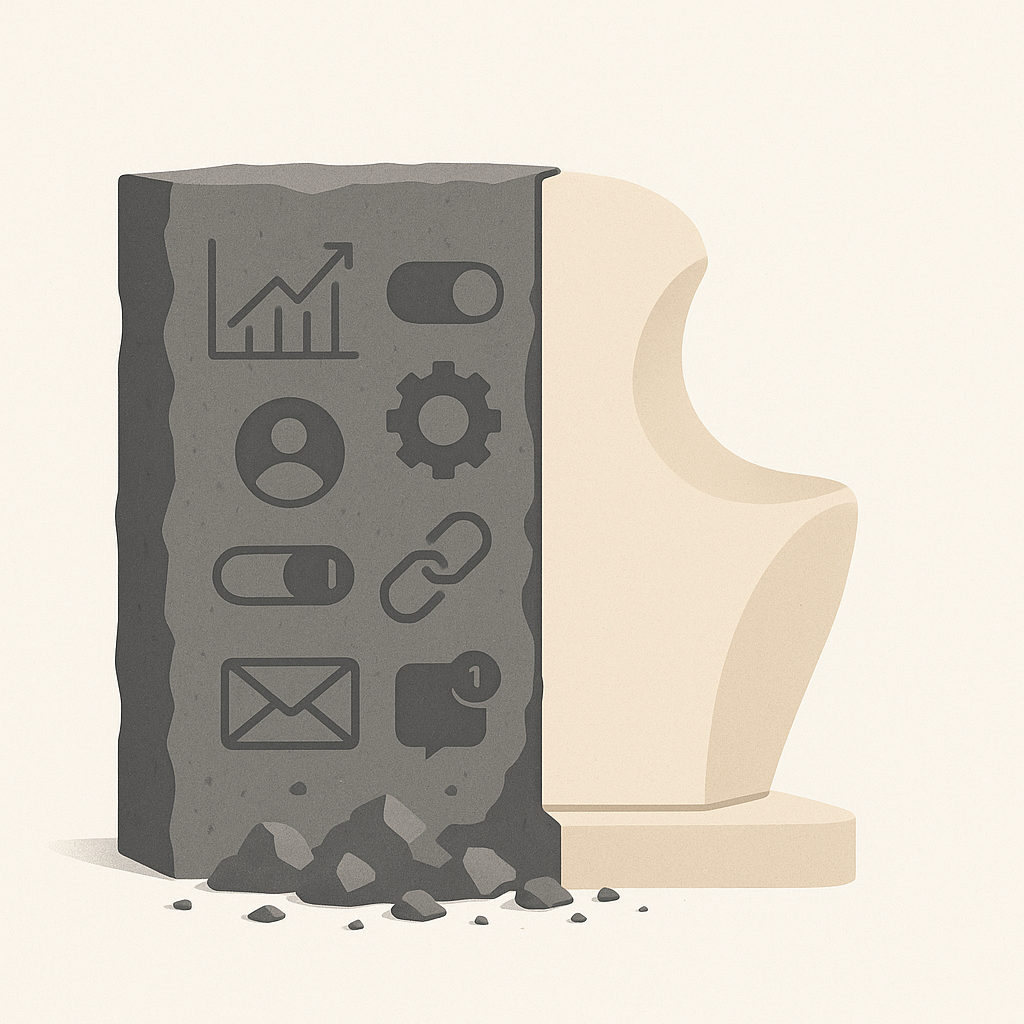
Jason Fried and David Heinemeier Hansson built Basecamp to 3M+ users with just 16 people. They discovered a counterintuitive truth that changed everything: You’re better off with a kick-ass half than a half-assed whole.
In other words: build half a product that works brilliantly rather than a complete product that works poorly. Google launched with just a search box. Instagram launched with just photo filters. They added everything else later.
Here’s what we’re going to cover:
- Why less is more (the half-product philosophy)
- The Epicenter Method (find your product’s core)
- The Curator Mindset (what you exclude matters more than what you include)
- How to cut your feature list by 75% and ship in 2 weeks
Let’s dive in.
💡 The Half-Product Philosophy
Most software companies play a game called “feature matching.”
See a rival with 20 features? Build 25. Competitor launches analytics? Add analytics. They add integrations? You add more integrations. This creates bloat without differentiation. You end up with a product that does everything poorly instead of anything exceptionally well.
There’s a better strategy: build half a product perfectly instead of a whole product poorly.
Think about Google’s homepage when it launched. Just a search box and two buttons. Yahoo had news, weather, stock quotes, horoscopes and 47 other things crammed onto their homepage.
Yahoo looked comprehensive.
Google looked incomplete.
Google won.
Or consider Instagram’s original release. Just photos. No direct messages. No Stories. No Reels. No shopping features. Just the ability to take a photo, apply a filter and share it. That’s it. They added everything else later, based on what users actually needed, not what they assumed users might want.
Basecamp followed the same approach. While project management competitors built 50+ features trying to be “complete,” Basecamp launched with 2 core features: message boards and to-do lists. That focus meant those 2 features worked brilliantly. The competition’s 50 features all worked okay, which means they all worked poorly.
The principle is simple: Half a great product is still great. A half-assed whole product is terrible.
Museums understand this instinctively. The Louvre displays about 35,000 works of art. Sounds impressive until you learn they have over 380,000 works in their collection. They show less than 10%. The Museum of Modern Art displays around 4,000 pieces but holds over 200,000. They show 2%.
Museums don’t try to show everything. They curate. They exclude. They make hard choices about what doesn’t make the cut.
That’s what makes them great, not warehouses.
But you’re probably thinking, “How do I decide what belongs in the ‘half’ I keep versus the ‘half’ I cut?”
🎯 The Epicenter Method: Find Your Product’s Core
Here’s the framework: Ask yourself, “If I took this away, would my product still exist?”
Everything that passes this test is your epicenter (the absolute core). Everything else is secondary decoration. Build the epicenter first, perfectly. Only then consider adding supporting features.
Think about a hotdog stand. The epicenter is hotdogs. Not the condiments, not the seating area, not even the location. If you have hotdogs, you have a hotdog stand. If you don’t, you have nothing.
Everything else is decoration around the core.
For Basecamp, the epicenter was message boards and to-do lists. Not file sharing. Not time tracking. Not Gantt charts. Not client portals. Just the ability to post messages and create tasks. That’s the core of project management. Everything else enhances the core but isn’t the core.
Most products are 90% decoration around a 10% core. They launched with all 100%, which meant the 10% that actually mattered worked okay instead of brilliantly. The 90% of decoration created complexity, slowed development and confused users.
Here’s your action step:
Pull out your feature list right now. Go through each planned feature and ask: “If I removed this, would my product still exist?” Be honest. Be brutal.
Circle only the features that pass this test. Not the features you want. Not the features competitors have. Only the features without which your product literally wouldn’t exist.
That circled list is your Version 1.
Everything else goes on the “maybe later” list.
You’ll be shocked at how small your core actually is. That’s good. It means you can build it exceptionally well and ship it in weeks instead of months.
Now that you know what to build, here’s how to resist the urge to add more.
✂️ The Curator Mindset: What You Exclude Defines You
Great products exclude most possibilities.
The hard part isn’t deciding what to include, it’s deciding what to leave out.
You don’t make a great museum by putting all the art in the world into a single room. That’s a warehouse. Museums curate. They show a sub-sub-subset of all available art. What they exclude matters more than what they include.
See your product as a curated exhibition, not a comprehensive catalog.
The same principle applies to products. Your product should be a curated subset of all possible features, not a comprehensive catalog of everything that could be built.
Whole Foods doesn’t sell Coke or Snickers. That’s a deliberate choice. They exclude products that don’t align with their values, even though those products would sell. The exclusion is what makes them Whole Foods instead of every other grocery store.
Vinnie’s Sub Shop in Delaware has a “no customizations” policy. You can’t remove ingredients or add extras. The subs come one way. This seems limiting until you realize it means every sub is perfect because they’ve optimized the exact recipe.
They’ve curated the experience by excluding options.
37signals (the company behind Basecamp) has a simple rule: Every feature request gets “no” by default. The answer is “no” unless there’s an overwhelming case for “yes.” They’ve said no to thousands of feature requests over the years. That’s why Basecamp remains focused and easy to use while competitors have become bloated and confusing.
Saying “no” to good ideas is one of the hardest things you’ll do. Every feature request sounds reasonable in isolation. “Could we add bulk editing?” Sure. “What about custom fields?” Makes sense. “Can we export to Excel?” Why not?
Before you know it, you’ve said yes to 50 “reasonable” requests and you have an unreasonably complex product.
Here’s your action step:
For every feature you add, try removing three existing features. Make your default answer to new ideas “no.” Require an overwhelming case for adding anything. Take pride in what you don’t do, not just what you do.
And if you’re thinking, “But what about all the features my competitors have?”
🏆 Underdo Your Competition
Most companies compete by addition.
Whatever they ship, you ship more. Whatever they announce, you announce bigger. This is called the “one-up” strategy. It’s exhausting and never-ending.
There’s a better approach: the “one-down” strategy.
Do less than your competition, but do it better.
In-N-Out Burger has 4 items on their menu. McDonald’s has over 50. Five Guys has 15. In-N-Out chose fewer options, which means they can execute those 4 items at legendary quality levels. They have a cult following. People travel to California specifically to eat at In-N-Out.
Nobody travels for McDonald’s menu complexity.
Fixed-gear bicycles are another example. Regular bikes have multiple gears, shifters, derailleurs and cables. Fixed-gear bikes removed all of that. Fewer parts, less maintenance, lighter weight, more direct connection to the road. They became popular not despite having less, but because they had less.
Your competitive advantage isn’t matching competitors feature-for-feature. It’s solving a simple problem better than anyone else.
When competitors are adding complexity, you win by adding simplicity.
When they’re adding features, you win by removing them.
Here’s your action step:
Look at what your competitors do that’s complex, confusing, or overwhelming. Do less than them, but make what you do absurdly good. The simplicity itself becomes your differentiator.
✅ Your Action Plan: Cut Features by 75%
Here’s exactly how to apply this to your product right now.
Step 1: List Everything (5 minutes)
Write down every feature you’ve planned. Every single thing on your roadmap. Don’t edit yet, just brain dump the complete list.
Step 2: Apply The Epicenter Test (10 minutes)
Go through each feature individually. For each one, ask: “If I removed this, would my product still exist?”
Be brutally honest. Not “Would it be better without this?” but “Would it still fundamentally be this product?”
Circle only the features that pass this test. Most features won’t pass. That’s normal and good.
Step 3: Cut in Half (5 minutes)
Look at your circled features (your epicenter). You probably circled 10-15 things. Cut half of them. Yes, really.
These aren’t bad features. They just don’t make your Version 1 cut. They go to the “Version 2” list.
Step 4: Cut in Half Again (5 minutes)
Look at what remains. Cut half again.
You’re now at roughly 25% of your original scope.
That’s your real MVP. That’s what you ship first.
Step 5: Build Only These Features (2 weeks)
Take your remaining 3-5 core features and build them exceptionally well. Not “good enough.” Exceptionally well.
Ship when this core works perfectly. Don’t add anything else before launching.
Step 6: Add Based on Real Feedback (ongoing)
After launch, real users will tell you what matters. Add features based on repeated requests from actual users, not assumptions about what hypothetical users might want.
Real example walkthrough:
Let’s say you started with 40 planned features.
After the Epicenter Test, you circled 15 features (only what you truly can’t remove).
After cutting in half, you have 7 features (Version 1).
After cutting in half again, you have 3 features (true MVP).
Ship these 3 features, but make them exceptional.
Add feature #4 only after launch, when users tell you what’s actually needed.
(And yes, it’s okay to start small. This is huge!)
🎬 Conclusion
The half-product philosophy isn’t about building less because you’re lazy or cutting corners.
It’s about building less so you can build better, faster.
Perfectionism becomes your limitation when it prevents shipping. Every month you spend adding features is a month you’re not learning from real users. Every “nice to have” feature you add is another thing that will break, need support and confuse users.
Most products fail by trying to do too much. Success comes from relentless focus on what matters, ruthless elimination of what doesn’t and shipping something great rather than waiting for something perfect.
You’re better off with a kick-ass half than a half-assed whole.
Here’s the big takeaway:
Pull up your feature list right now. Apply the Epicenter Method. Circle only what you absolutely cannot remove. Cut that list in half. Cut it in half again. Build that 25%, but make it exceptional.
Ship in 2 weeks, not 3 months.
The market will tell you what comes next. But only after you ship.
🚀 Take Action Now
What’s the one feature your product absolutely cannot exist without?
Identify it today, build only that and ship next week.
Read “Rework” by Jason Fried and David Heinemeier Hansson for 86 contrarian business principles like this that actually work.