⚡ The Lightning Summary
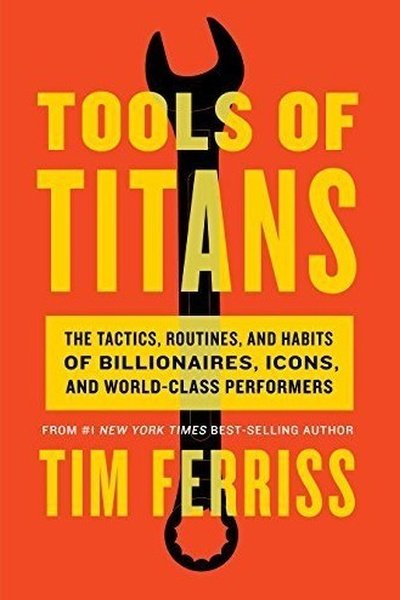
Tools of Titans is a distilled playbook of wisdom from over 200 world-class performers interviewed on Tim Ferriss’s podcast. The core message is that success is not about superhuman abilities but about adopting field-tested beliefs, habits and uncommon questions that high performers use. World-class performers are “walking flaws who’ve maximized 1 or 2 strengths” and have crafted rules that allow them to bend reality. The book is structured around Ben Franklin’s “healthy, wealthy and wise” framework, providing tactics across physical optimization, business success and life philosophy. Success is achievable through collecting the right field-tested beliefs and habits, recognizing that everyone struggles, including titans.
⭐ The One Thing
The quality of your life is determined by the quality of your questions. Most people focus on optimizing answers when they should be optimizing the questions they ask themselves. Questions determine your focus and priorities. Peter Thiel’s accelerator question exemplifies this: “If you have a 10-year plan, why can’t you do this in 6 months?” The book aims to help you develop three core skills inspired by Siddhartha: “I can think” (having good rules for decision-making and powerful questions), “I can wait” (planning long-term without misallocating resources), and “I can fast” (withstanding difficulties and developing high pain tolerance). Small consistent actions matter more than big sporadic ones, and success comes from finding the field-tested beliefs that work for your unique idiosyncrasies.
💭 First Impressions
Derek Sivers’s “Hell Yeah or No” decision framework immediately helped me say no to mediocre commitments, providing instant clarity. The “superheroes are nearly all walking flaws who’ve maximized 1 or 2 strengths” maxim is genuinely comforting and makes success feel accessible rather than reserved for the naturally gifted. Perhaps most striking was learning that over 80% of interviewed performers meditate or have meditation-like practices, making the case for meditation undeniable through sheer weight of evidence.
🔑 Key Concepts
-
Question Quality Over Answer Quality: Tony Robbins states “the quality of your life is the quality of your questions.” Questions determine focus and priorities. Peter Thiel asks “If you have a 10-year plan, why can’t you do this in 6 months?” to force unconventional thinking. Most people spend insufficient time with ridiculous-seeming questions. Spending real time journaling about absurd questions can be life-changing because they force you to examine assumptions.
-
Small Consistent Actions Over Big Sporadic Ones: “It’s the small things, done consistently, that are the big things.” This concept appears throughout the book whether in morning rituals, meditation, exercise or journaling. The emphasis is on building sustainable systems rather than relying on motivation or willpower. Scott Adams says “Losers have goals. Winners have systems.” Systems compound over time while motivation fluctuates.
-
Efficacy Over Efficiency: Ferriss distinguishes between doing things quickly (efficiency) and doing the right things (efficacy). His 8-step morning process focuses on identifying the 3-5 things causing most anxiety and asking “If this were the only thing I accomplished today, would I be satisfied?” The key question is “What, if done, will make all of the rest easier or irrelevant?” Being busy is reframed as “a form of laziness—lazy thinking and indiscriminate action.”
-
The Power of Saying No: Derek Sivers’s “Hell Yeah or No” philosophy states “If I feel anything less than ‘Wow! That would be amazing! Absolutely! Hell yeah!’ – then my answer is no.” Once you reach decent professional success, lack of opportunity won’t kill you. Drowning in “kinda cool” commitments will sink the ship. Saying no to most things leaves room to throw yourself completely into rare things that make you say “Hell yeah!”
-
Fear-Setting Over Goal-Setting: Rather than just setting positive goals, Ferriss advocates examining worst-case scenarios systematically. Seneca’s practice: “Set aside certain days to be content with the scantiest and cheapest fare… ‘Is this the condition that I feared?'” Fear-setting involves asking three questions: What are the worst things that could happen? What could I do to prevent each? What could I do to repair each if it happened? This removes phantom fears and enables bold action.
🧠 Mental Models & Frameworks
-
The 80/20 Analysis with the “Easy” Filter: Use this when prioritizing activities for maximum impact with minimal friction. Reid Hoffman’s approach starts with traditional 80/20 analysis—identify which 20% of activities produce 80% of results. Then add “easy” as next criterion: “Which of these highest-value activities is the easiest for me to do?” This creates a two-dimensional filter that optimizes for both impact and sustainability. High-impact activities that are easy lead to flow and compound gains.
-
State → Story → Strategy: Use this when problem-solving while stuck or feeling overwhelmed. Tony Robbins’s framework recognizes that your physiological state determines the story you tell yourself, which determines your strategy. Rather than trying to change strategy first, change your state through movement, breath or focus shift. When depressed, exhausted or anxious, you tell limiting stories that generate poor strategies. When energized, confident and present, you tell empowering stories that generate creative strategies.
-
The Three Options Framework: Use this when feeling stuck in any situation causing misery. Naval Ravikant’s approach: “You can change it, you can accept it, or you can leave it.” The problematic fourth option is to sit around wishing you would change it but not changing it, wishing you would leave it but not leaving it, and not accepting it. Acceptance is a valid choice, not passive resignation. This removes victimhood and the energy drain of constant internal resistance.
-
Morning Pages as “Spiritual Windshield Wipers”: Use this for daily mental hygiene and anxiety management. Julia Cameron’s practice of writing 3 pages longhand every morning to “cage your monkey mind on paper.” The purpose is not productivity or finding ideas—it is therapy. “Once we get those muddy, maddening, confusing thoughts on the page, we face our day with clearer eyes.” No one will read these pages. They are for trapping thought, not communicating it.
-
The “What Would This Look Like If It Were Easy?” Framework: Use this when tackling challenges that feel overwhelming or unnecessarily complex. This mental model forces consideration of simpler paths and helps identify when you’re creating unnecessary complexity. Related to Reid Hoffman’s insight to “solve the simplest, easiest, and most valuable problem.” Most people make things harder than necessary out of cultural conditioning that equates difficulty with value.
💬 My Favorite Quotes
The quality of your life is the quality of your questions.
If you have a 10-year plan of how to get somewhere, you should ask: Why can’t you do this in 6 months?
The superheroes you have in your mind are nearly all walking flaws who’ve maximized 1 or 2 strengths.
🙋 Who Should Read It?
-
High achievers feeling scattered who sense they could have more impact with better systems, entrepreneurs seeking field-tested tactics rather than trial and error, or people drowning in information who struggle to identify what actually matters and what to implement.
-
Career transitioners contemplating major life changes who need perspective from those who’ve made similar leaps, productivity enthusiasts hitting plateaus who need next-level mental models, or anyone feeling stuck in patterns they cannot break who need new frameworks.
-
Peak performers in one domain wanting to translate success principles to other areas of life, people facing fears around major decisions who need systematic frameworks for overcoming resistance, or those seeking authenticity tired of guru promises wanting honest perspectives from real practitioners.
🔗 Additional Resources
Most-Gifted Books Across All Guests:
- Tao Te Ching by Lao Tzu (5 mentions)
- Atlas Shrugged by Ayn Rand (4 mentions)
- Sapiens by Yuval Noah Harari (4 mentions)
- Siddhartha by Hermann Hesse (4 mentions)
- The 4-Hour Workweek by Tim Ferriss (4 mentions)
- The Checklist Manifesto by Atul Gawande (4 mentions)
- Influence by Robert Cialdini (3 mentions)
- Zero to One by Peter Thiel (3 mentions)
Key Frameworks Referenced:
- Meditation as meta-skill training
- Fear-setting (Stoic premeditatio malorum)
- Morning rituals and morning pages (Julia Cameron)
- 80/20 analysis with “easy” filter (Reid Hoffman)
- State → Story → Strategy (Tony Robbins)
- Hell Yeah or No decision filter (Derek Sivers)
- The Three Options (Naval Ravikant)
Philosophy and Wisdom:
- Marcus Aurelius’s Meditations
- Seneca on Stoicism and voluntary discomfort
- Naval Ravikant’s collected wisdom
- Derek Sivers on simplicity and focus