
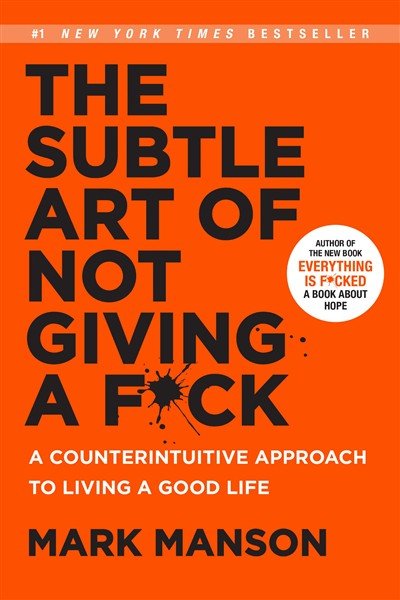
⚡ The Lightning Summary
Stop trying to be positive all the time. Life is about choosing what to care about based on good values. Happiness comes from solving problems you enjoy solving, not avoiding problems. Accept suffering as inevitable, take responsibility for your reactions, embrace uncertainty and failure, and commit deeply to what truly matters.
⭐ The One Thing
The one thing this book taught me: You will always have problems and limitations. The key to a good life is not eliminating them but choosing better problems based on better values. What you choose to give a fuck about determines the quality of your life.
💭 First Impressions
The counterintuitive nature of his arguments (pursuing positive feelings creates negativity, accepting negativity creates positivity) forces you to question conventional wisdom. Reading this feels less like traditional self-help and more like having a beer with a philosophically-minded friend who refuses to coddle you. The profanity-laden title initially seems like shock value marketing, but the message underneath is surprisingly philosophical and grounded.
🔑 Key Concepts
-
The Backwards Law: The more you pursue feeling better all the time, the less satisfied you become. Pursuing something only reinforces that you lack it. Conversely, accepting your negative experiences is itself a positive experience. This creates a paradox where the path to happiness runs through accepting unhappiness.
-
The Feedback Loop from Hell: Feeling bad about feeling bad creates a spiral of anxiety and self-loathing. Social media amplifies this by constantly exposing us to curated highlights of others’ lives, making us feel inadequate about our average existence. Breaking this loop requires not giving a fuck about feeling bad in the first place.
-
Problems Are Inevitable: Life is an endless series of problems. The solution to one problem merely creates the next one. Happiness isn’t found in a problem-free life (which doesn’t exist) but in finding problems you enjoy solving. Who you are is defined by what you’re willing to struggle for.
-
The Three Levels of Self-Awareness: First level is understanding your emotions. Second level is asking why you feel certain emotions. Third level (the deepest and most important) is examining your personal values: by what standard are you measuring yourself? This determines the nature of your problems and thus the quality of your life.
-
Radical Responsibility: You are always responsible for how you interpret and respond to events, even when you’re not at fault for what happened. This distinction between fault and responsibility is crucial. Taking responsibility for your problems is the first step to solving them, while blaming others only hurts yourself.
🧠 Mental Models & Frameworks
-
Good Values vs Bad Values Framework: Use this when evaluating whether your life priorities are serving you well. Good values are reality-based, socially constructive, immediate and controllable (honesty, innovation, vulnerability). Bad values are superstitious, socially destructive, not immediate or controllable (pleasure, material success, always being right, staying positive). Audit your current values by asking whether they’re within your control and whether pursuing them makes your life better or worse.
-
Manson’s Law of Avoidance: Use this when you notice yourself procrastinating or avoiding something important. The more something threatens your identity, the more you will avoid it. If you see yourself as naturally smart, you’ll avoid situations that might prove otherwise. If you see yourself as a victim, you’ll avoid taking responsibility. Notice what you’re avoiding and ask what identity that behavior is protecting.
-
The Do Something Principle: Use this when you’re stuck waiting for motivation to strike. Action isn’t just the effect of motivation, it’s also the cause. The loop is: Inspiration → Motivation → Action → Inspiration (repeat). You can enter this loop at any point. If you lack motivation, take the smallest possible action related to your goal. The momentum from that action will generate motivation for the next step.
-
The Choice Framework: Use this when feeling powerless or victimized by circumstances. You don’t always control what happens to you, but you always control how you interpret and respond. Even choosing not to respond is a response. When something bad happens, ask “What am I choosing to make this mean?” and “How am I choosing to respond?” This shifts you from victim to agent.
-
Rejection as Definition: Use this when trying to figure out what you truly value or commit to. To value something, you must reject what is not that something. To value X, you must reject non-X. Commitment to one thing requires rejection of alternatives. Without rejection, you stand for nothing and life becomes meaningless. Your rejections reveal your true values more than your aspirations.
💬 My Favorite Quotes
The desire for more positive experience is itself a negative experience. And, paradoxically, the acceptance of one’s negative experience is itself a positive experience.
Who you are is defined by what you’re willing to struggle for.
There is a freedom and liberation in commitment. I’ve found increased opportunity and upside in rejecting alternatives and distractions in favor of what I’ve chosen to let truly matter to me.
🙋 Who Should Read It?
-
People stuck in the endless self-help loop of trying to be positive all the time, only to feel worse about themselves when they inevitably feel negative emotions.
-
Young professionals experiencing quarter-life or mid-life crises, questioning whether their pursuit of success and status is actually making them happy.
-
Anyone paralyzed by fear of failure who needs permission to accept that failure is not only inevitable but necessary for growth.
🔗 Additional Resources
Philosophical Foundations:
- Albert Camus and existentialist philosophy on meaning and absurdity
- Buddhist philosophy on suffering and acceptance
- Stoicism (Marcus Aurelius, Epictetus) on control and response
- Alan Watts on “the backwards law” and paradoxical intention
Related Books:
- “Man’s Search for Meaning” by Viktor Frankl
- “The Four Agreements” by Don Miguel Ruiz
- Works on Stoic philosophy
Psychological Concepts:
- Hedonic treadmill and adaptation
- Cognitive behavioral therapy principles
- Self-determination theory on intrinsic vs extrinsic motivation
- Identity and ego protection mechanisms
Complementary Frameworks:
- The Growth Mindset (Carol Dweck) pairs well with accepting failure
- Essentialism (Greg McKeown) complements choosing what to give a fuck about
- Mindfulness practices support the self-awareness framework