
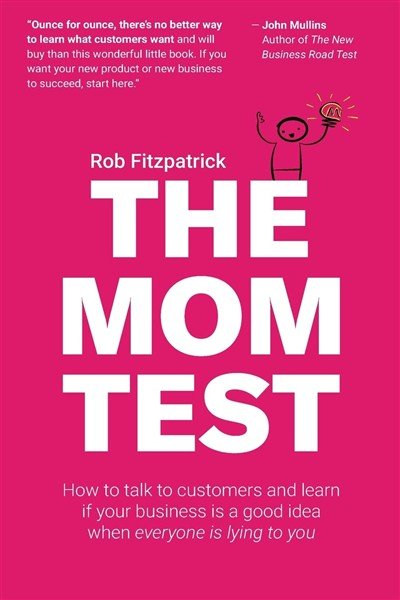
⚡ The Lightning Summary
The Mom Test teaches entrepreneurs how to extract honest feedback from potential customers by asking about their lives instead of pitching ideas. Instead of asking “Would you buy this?”, learn to ask about specific past behaviors, current problems and real workflows. The goal is gathering facts and commitments, not compliments. When done right, even your mom can’t lie to you because you’re never talking about your idea – you’re uncovering concrete truths about their world that reveal whether your business has merit.
⭐ The One Thing
The one thing this book taught me: Stop seeking validation for your idea and start discovering the truth about your customers’ problems. Your job isn’t to get people to like your idea – it’s to understand their lives so deeply that you can build something they’ll actually pay for. They own the problem, you own the solution.
💭 First Impressions
The amount of self-sabotage happening when entrepreneurs fish for compliments instead of facts was genuinely surprising. The conversational examples throughout make abstract principles immediately concrete and actionable, transforming theoretical concepts into something you can use in your next conversation. The title itself is brilliant—using “mom” as the ultimate test of whether questions are good enough to penetrate natural human politeness creates an instantly memorable framework.
🔑 Key Concepts
-
The Mom Test Framework: Three simple rules that prevent people from lying to you—talk about their life instead of your idea, ask about specifics in the past instead of generics or opinions about the future, and talk less and listen more. This shifts conversations from validation-seeking to truth-finding.
-
Compliments are Worthless: When customers say they love your idea, that’s the fool’s gold of customer learning—shiny, distracting and entirely worthless. What matters are concrete facts about their current behavior, problems they’re actively solving and commitments they’re willing to make. Compliments cost them nothing, so they mean nothing.
-
The Three Types of Bad Data: Compliments (fishing for approval), fluff (generics, hypotheticals and future-tense promises) and ideas (feature requests without understanding the underlying motivation). Each type feels like progress but actually leads you astray by giving false positives or obscuring what customers really need.
-
Commitment and Advancement: The only way to know if feedback is real is to ask for commitment—time, reputation risk or money. Every meeting should either advance to the next step of your real-world funnel or clearly reveal they’re not a customer. Both outcomes are valuable. Meetings that end with “that went well” but no clear next steps are worthless.
-
Customer Segmentation as Focus: Startups don’t starve, they drown. You need to slice your customer segment down until you have a specific who-where pair—who exactly needs this and where can you find them. Talking to “everyone” means you’re having one conversation each with 20 different customer types, leading to contradictory feedback and paralysis.
🧠 Mental Models & Frameworks
-
The Mom Test Questions: Use this when having any customer conversation, especially in early stages. Replace questions about your idea with questions about their life. Instead of “Would you buy this?” ask “How are you dealing with this now?” “When’s the last time that happened?” “What have you tried?” This forces concrete past examples instead of hypothetical future promises. Redirect to understanding their current reality before pitching or seeking validation.
-
Signal Anchoring: Use this when someone gives generic or fluffy answers. Take generic claims like “I always do X” and anchor them with specific examples—”What’s your inbox at right now?” “When’s the last time it fell apart?” This reveals the gap between who people want to be and who they actually are. Whenever you hear “usually” or “always,” immediately follow up with “tell me about the last time” to get concrete facts.
-
Dig Beneath Feature Requests: Use this anytime someone suggests what you should build. Don’t add requests to your todo list. Instead ask “Why do you want that?” “What would that let you do?” “How are you coping without it?” Understanding the motivation reveals simpler solutions or shows the request isn’t actually important. Treat every “you should build X” as a signal to dig deeper, not a feature to add.
-
Commitment Currency: Use this in mid to late stage conversations when you have something to show. Measure how serious someone is by what they’re willing to give up—time (clear next meeting, trial usage), reputation risk (intros to team, public testimonial) or money (pre-order, deposit). The more they give up, the more you can trust their words. End every product conversation by pushing for a clear commitment, otherwise you’re just collecting compliments.
-
Customer Slicing: Use this when getting contradictory feedback or feeling overwhelmed. Start broad, then repeatedly ask “Within this group, who would want it most?” “Why do they want it?” “Where can I find them?” until you have a specific who-where pair. Then prioritize by most profitable, easy to reach and rewarding to serve. If you can’t describe exactly where to find 10 potential customers right now, your segment is still too broad.
💬 My Favorite Quotes
It’s not anyone else’s responsibility to show us the truth. It’s our responsibility to find it. We do that by asking good questions.
Watching someone do a task will show you where the problems and inefficiencies really are, not where the customer thinks they are.
Compliments are the fool’s gold of customer learning: shiny, distracting and entirely worthless.
🙋 Who Should Read It?
-
Early-stage founders building their first product who are about to spend months building something based on what a few people said they’d like—this book could save you from wasting that time on the wrong thing.
-
Entrepreneurs who keep getting “positive feedback” but no sales where everyone says they love the idea but nobody’s buying—you’re probably fishing for compliments instead of finding truth, and this book shows you what you’re missing.
-
Product managers struggling with contradictory user feedback where customers are asking for conflicting features and you can’t figure out what to build—you likely have a segmentation problem this book addresses.
🔗 Additional Resources
Books Referenced:
- “The Four Steps to the Epiphany” by Steve Blank
- General lean startup methodology and principles
Related Frameworks:
- Jobs to Be Done theory
- Lean Startup methodology
- Customer Development process
- Value Proposition Design
Complementary Reading:
- “Running Lean” by Ash Maurya
- “The Lean Product Playbook” by Dan Olsen
- “Competing Against Luck” by Clayton Christensen
- “Obviously Awesome” by April Dunford
- “Traction” by Gabriel Weinberg