
⚡ The Lightning Summary
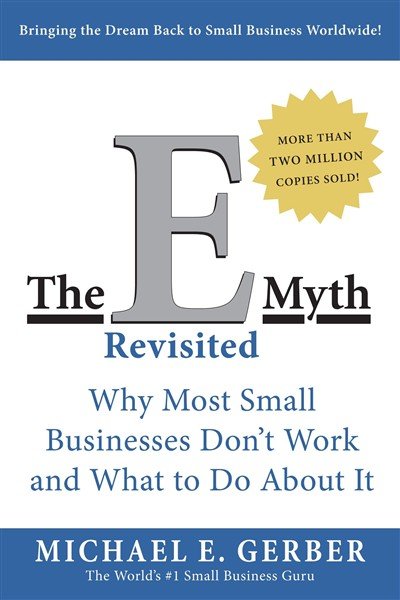
Most small businesses fail because they’re started by technicians having an “Entrepreneurial Seizure” – people who know how to DO the work but not how to BUILD a business. The solution: build your business as if you’re franchising it. Create systems for everything, document all processes and work ON your business (strategy) not IN it (operations). Transform from being the business to owning a business that works without you.
⭐ The One Thing
The one thing this book taught me: The business IS the product, not what you sell. Your job isn’t to be the best technician delivering your service, it’s to build a system that consistently delivers that service without you. When you shift from asking “What work needs to be done?” to “How must the business work?”, everything changes. You’re no longer trapped in your business – you own an asset that serves your life.
💭 First Impressions
“Work ON your business, not IN it” feels revolutionary yet obvious – once stated, it’s so clear, but most business owners spend 95% of time IN the business doing tactical work. The “Primary Aim” exercise starting with “what do you want your life to look like?” before business strategy is unexpected in a business book, but makes sense since your business should serve your life, not consume it. The book provides both philosophy (why systems matter) and practical tools (Operations Manuals, Organization Charts, Position Contracts).
🔑 Key Concepts
-
The Entrepreneurial Myth (E-Myth): The fatal assumption that if you understand the technical work of a business, you understand a business that does that technical work. This myth causes 80% of small businesses to fail within five years. The baker who loves baking opens a bakery and becomes trapped doing bookkeeping, hiring, marketing and management – everything except what they love. The business becomes their job, not their asset.
-
The Three Personalities: Every business owner contains three conflicting personas: The Entrepreneur (visionary who lives in the future and craves change), The Manager (pragmatist who lives in the past and craves order) and The Technician (doer who lives in the present and loves the work itself). Healthy businesses balance these at roughly equal thirds. Failed businesses are 70% Technician, 20% Manager and 10% Entrepreneur.
-
The Franchise Prototype: Build your business as if you’re going to franchise it to 5,000 locations, even if you never will. This forces you to create documented systems that work predictably with ordinary people operating them. The business becomes replicable, sellable and ultimately valuable. You’re not building a job – you’re building a product (the business itself) that can be reproduced.
-
Innovation, Quantification, Orchestration: The three-step Business Development Process. Innovation: try new ways of doing things. Quantification: measure everything with numbers to know what works. Orchestration: once something works, eliminate discretion and do it the same way every time. This cycle of continuous improvement, measurement and standardization is how ordinary businesses become extraordinary.
-
Work ON Your Business, Not IN It: The fundamental distinction between strategic work (building systems, creating processes, designing the business) and tactical work (doing the service, serving customers, executing the work). Technicians work IN their business and get trapped. Entrepreneurs work ON their business and gain freedom. Your goal is to make yourself unnecessary to daily operations.
🧠 Mental Models & Frameworks
-
The Franchise Prototype Lens: Use this any time you’re designing a process or solving an operational problem. Ask “If I had to teach 5,000 locations to do this, how would I document it?” Forces you to create systems instead of relying on your personal heroics or tribal knowledge. Makes you think in terms of training, documentation and replicability. When building any new process, document it as if someone with zero experience will need to follow it.
-
The Three Life Phases of a Business: Use this when diagnosing why your business feels stuck or chaotic. Infancy (you ARE the business), Adolescence (getting help but losing control), Maturity (systems-driven operation that works without you). Most businesses get stuck in Adolescence, cycling between “getting small again” (firing everyone) and “going for broke” (desperate expansion). Maturity requires building with the end in mind from the beginning.
-
The Organization Chart Before People: Use this before hiring anyone or when reorganizing. Design the org chart based on FUNCTIONS needed (not personalities you have). Create Position Contracts defining each role. Initially, you’ll wear multiple hats, but keeping roles distinct prevents chaos. As you grow, you fill positions rather than inventing them around people.
-
The Central Demographic Model: Use this when making any marketing or product decision. Define exactly WHO your customer is (demographics) and WHY they buy (psychographics, their emotional needs). Every business decision should serve this specific customer profile. Trying to serve everyone means serving no one well.
-
Systems Thinking: Hard, Soft and Information Systems: Use this when solving any recurring business problem. Hard Systems are inanimate (equipment, colors, facilities). Soft Systems are living or idea-based (people, scripts, processes). Information Systems are data about interactions (metrics, reports, dashboards). Every business problem can be solved by designing better systems in these three categories.
💬 My Favorite Quotes
Work ON your business, not IN it.
Great businesses are not built by extraordinary people but by ordinary people doing extraordinary things.
Your business is not your life. Your business and your life are two totally separate things. Your business should serve your life, not consume it.
🙋 Who Should Read It?
-
Small business owners feeling trapped in their business – if you can’t take a vacation without everything falling apart, if you’re working 60+ hour weeks doing everything yourself, if your business feels like a demanding job rather than an asset, this book provides the escape plan through systems thinking.
-
Technicians considering starting a business – if you’re great at your craft (design, consulting, coaching, trades, services) and thinking “I should start my own business,” read this BEFORE you start. It will save you from the Entrepreneurial Seizure trap that kills 80% of small businesses.
-
Solo entrepreneurs ready to scale beyond themselves – if you’ve successfully built a one-person operation but can’t figure out how to grow without losing quality or control, this book teaches how to document your expertise into systems that others can execute.
🔗 Additional Resources
Books Referenced or Related:
- “Built to Sell” by John Warrillow (building a business you can sell)
- “The Goal” by Eliyahu Goldratt (Theory of Constraints and systems thinking)
- “Traction” by Gino Wickman (EOS, Entrepreneurial Operating System)
- “Scaling Up” by Verne Harnish (Rockefeller Habits for growing companies)
- “Work the System” by Sam Carpenter (similar systems thinking approach)
Companies and Case Studies:
- McDonald’s/Ray Kroc (the quintessential franchise prototype example)
- IBM/Tom Watson (building with the end vision in mind)
- Federal Express (systems excellence)
Key Concepts to Explore Further:
- Business Process Management (BPM)
- Standard Operating Procedures (SOPs)
- Lean methodology
- Six Sigma
- Theory of Constraints
Process Documentation Tools:
- Trainual
- Process Street
- SweetProcess
- Confluence/Notion for internal wikis