
⚡ The Lightning Summary
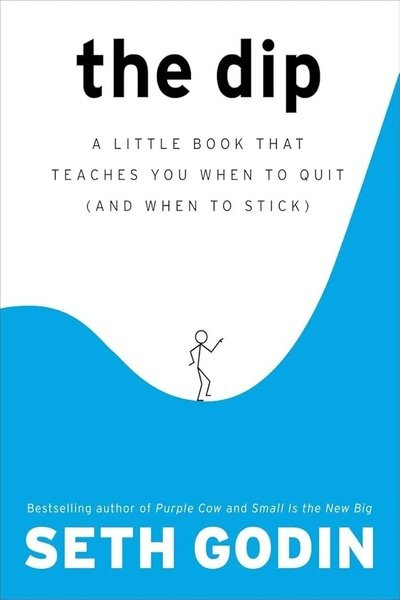
Winners don’t just persevere—they strategically quit the right things at the right time. Success requires identifying which pursuits have a valuable Dip worth pushing through, which are dead-end Cul-de-Sacs to abandon immediately, and which are dangerous Cliffs to avoid entirely. The marketplace rewards scarcity and exceptional excellence, so your job is to become “the best in the world” in your chosen niche by quitting everything else and leaning into the difficult middle period that separates starters from masters.
⭐ The One Thing
The one thing this book taught me: Strategic quitting is not failure—it’s the defining characteristic of successful people who understand that being average at multiple things is worse than being exceptional at one thing, and that the only sustainable competitive advantage in a world of abundance is becoming “the best in the world” in a carefully chosen, winnable market.
💭 First Impressions
This book is deceptively simple. At 80 pages, it feels like it could be a blog post, but the framework is profound—the three curves model (Dip, Cul-de-Sac, Cliff) provides instant clarity for decision-making. The counterintuitive thesis that “winners quit all the time” immediately challenges everything we’ve been taught about perseverance, which makes it both uncomfortable and liberating. Reading this felt like getting permission to stop doing things I knew weren’t working, which is oddly powerful in a culture that glorifies “never giving up.”
🔑 Key Concepts
-
The Three Curves Framework: Every pursuit follows one of three paths—the Dip (hard middle worth pushing through), the Cul-de-Sac (dead end with no progress), or the Cliff (deceptively pleasant but catastrophic end). Understanding which curve you’re on is the key to making smart quitting decisions. Most people quit Dips too early and stay in Cul-de-Sacs too long.
-
Scarcity Creates Value: The Dip exists specifically to create scarcity by filtering out people who quit. If it was easy to become the best, everyone would do it and there would be no competitive advantage. The difficulty is not a bug—it’s a feature that ensures only the committed reach the top and reap disproportionate rewards.
-
Best in the World (Redefined): You don’t need to be globally best—you need to be best in your chosen market. “Best” means “best for them, right now, based on what they believe and know,” and “world” means “their world, the world they have access to.” This makes excellence achievable through strategic market selection rather than impossible through global competition.
-
Strategic vs. Reactive Quitting: Strategic quitting is a conscious decision made before you start, based on clear criteria about when to stop. Reactive quitting is panic-driven, emotional, and typically happens at the worst time. Winners decide their quitting conditions in advance and stick to them, while losers make decisions based on how they feel in the moment.
-
The Woodpecker Principle: A woodpecker can tap 20 times on 1,000 trees and get nowhere, or tap 20,000 times on one tree and get dinner. Focus and persistence on the right thing beats diversification and dabbling. Most people fail not from lack of effort but from spreading effort across too many pursuits, quitting none of them.
🧠 Mental Models & Frameworks
-
The Three Questions Framework: Use this before making any quitting decision. Ask yourself: Am I panicking? (never quit in panic), Who am I trying to influence—one person or a market? (one person is a wall that gets higher; a market is a hill that gets easier), What measurable progress am I making? (forward, backward, or standing still). Use this checklist before abandoning any project, job, or strategy to ensure you’re making a strategic rather than emotional decision.
-
The Soft Tires Principle: Use this when entering a new market or evaluating resource allocation. Like inflating a bicycle tire, the first 10 PSI does nothing on a flat tire, the middle 10-15 PSI creates maximum impact, and the last 10 PSI risks blowout. Match your resources (pressure) to your target market size (tire)—not too big, not too small. Before launching products or campaigns, calculate if your resources are sufficient to reach critical mass in your chosen market.
-
Wall vs. Hill Model: Use this when deciding whether persistence will pay off. Influencing one person/gatekeeper is like scaling a wall—each rejection makes it harder (you become a pest). Influencing a market is like climbing a hill—each step makes progress easier because people talk to each other and amplify your message. If you’re stuck trying to convince one decision-maker, quit and find a market. If you’re building in a market, keep going because it gets easier.
-
Pre-Commitment Framework: Use this at the start of any difficult pursuit. Dick Collins (ultramarathoner) principle—”Decide before the race the conditions that will cause you to stop and drop out.” Write down your quitting criteria in advance so you don’t make emotional decisions mid-race. Before starting projects, write down specific, measurable conditions that would trigger strategic quitting.
-
Quit Tactics, Keep Strategy: Use this when facing obstacles or failures. Distinguish between tactics (specific products, features, approaches) and strategy (market commitment, long-term vision). Quit tactics freely and frequently; keep strategy unless you’re in a Cul-de-Sac. When something isn’t working, ask “Should I quit this specific approach (tactic) or quit this entire market (strategy)?”
💬 My Favorite Quotes
Winners quit all the time. They just quit the right stuff at the right time.
The Dip creates scarcity. Scarcity creates value.
The next time you catch yourself being average when you feel like quitting, realize that you have only two good choices: Quit or be exceptional. Average is for losers.
🙋 Who Should Read It?
-
Entrepreneurs and founders who are juggling multiple projects or pivoting constantly without achieving breakthrough success—this will help you focus ruthlessly on the one thing that matters.
-
Mid-career professionals feeling stuck in roles or industries where they’ve plateaued, unsure whether to persist or change course—the framework clarifies when you’re in a valuable Dip vs. a dead-end Cul-de-Sac.
-
Anyone spreading themselves too thin across hobbies, side hustles, or opportunities, making marginal progress on everything but breakthroughs on nothing—the woodpecker metaphor will hit hard.
🔗 Additional Resources
Related Books by Seth Godin:
- “Linchpin” – Expands on becoming indispensable (the “best in the world” concept)
- “Purple Cow” – Focuses on being remarkable in the marketplace
- “Tribes” – Explores leading and influencing markets vs. individuals
Complementary Frameworks:
- “Good to Great” by Jim Collins – Level 5 leadership and the flywheel concept
- “The Lean Startup” by Eric Ries – Pivot vs. persevere decisions based on validated learning
- “Essentialism” by Greg McKeown – Doing less but better, strategic elimination
- “Range” by David Epstein – Challenges specialization narrative with generalist success stories
Research and Models Referenced:
- Zipf’s Law – Power law distribution in rankings and market share
- Sunk cost fallacy – Behavioral economics explaining why quitting is hard
- Strategic management research – Porter’s competitive advantage and focus strategies