⚡ The Lightning Summary
Society’s broken scoreboard measures wealth purely by money, leaving us feeling empty despite financial success. Bloom redefines wealth across five dimensions – Time, Social, Mental, Physical and Financial – providing frameworks to measure what truly matters and actionable systems to build a life of fulfillment, not just achievement.
⭐ The One Thing
The one thing this book taught me: True wealth isn’t measured by your bank account but by the quality of your relationships, the control over your time, the clarity of your purpose, the health of your body and the freedom from endless wanting. Never let the quest for more distract you from the beauty of enough.
💭 First Impressions
The opening math broke me – “You’ll see your parents 15 more times before they die” hit like a gut punch and immediately reframed everything about how I think about time. The dimensionality surprised me, as I didn’t expect physical and mental wealth to get equal billing with financial wealth in a “wealth” book. What makes the advice credible is Bloom’s refreshing honesty and vulnerability about making millions at 30 while feeling miserable – it gives the book authenticity that most wealth guides lack.
🔑 Key Concepts
-
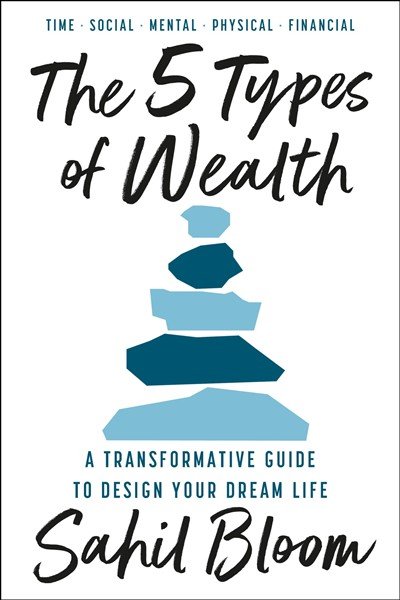
The Five Types of Wealth Framework: True wealth exists across five dimensions – Time (control over your schedule), Social (depth and breadth of relationships), Mental (purpose, growth and space), Physical (health and vitality) and Financial (assets minus liabilities AND expectations). Measuring only Financial Wealth while neglecting the others guarantees emptiness despite material success. This matters because it provides a comprehensive scoreboard for life decisions.
-
The Arrival Fallacy: The false belief that achieving a goal will create lasting satisfaction and contentment. We incorrectly assume we’ll experience the sensation of having “arrived” when reaching our destination. This explains why hitting financial milestones (first $100K, first million, etc.) feels briefly satisfying before the goalpost moves again. Understanding this prevents the endless hedonic treadmill.
-
The Scoreboard Problem: “What gets measured gets managed” – Peter Drucker. Society’s broken scoreboard forces us into narrow measurements of success defined entirely by money. Since the metrics we measure dictate our priorities and actions, using the wrong scoreboard means optimizing for the wrong outcomes. Fixing the scoreboard is prerequisite to living well.
-
Bought Status vs. Earned Status: Bought status includes luxury goods, exclusive memberships and material displays meant to impress others. Earned status includes time freedom, loving relationships, purpose-driven work, sought-after wisdom, adaptable mind, strong physique and hard-won professional success. Bought status is fragile and comparative. Earned status is lasting and intrinsic. This distinction clarifies which pursuits create real wealth.
-
The Dimmer Switch (Not On/Off): Each wealth type exists on a continuum, not as binary states. You can’t leave any type “off” for too long or it atrophies, but different life seasons naturally emphasize different types. The key is maintaining a minimum baseline across all five while consciously choosing where to focus additional energy. This framework liberates you from the impossible standard of maximizing everything simultaneously.
🧠 Mental Models & Frameworks
-
The Wealth Score Assessment: Use this as a starting point for any life redesign or when feeling generally unfulfilled but unable to pinpoint why. Rate yourself 0-4 on five statements for each wealth type (25 statements total, 100 points maximum). The scores reveal which dimensions need attention and create a baseline to track progress over time. Take the assessment quarterly to identify which wealth types are slipping and need focus in the coming season.
-
The Life Razor: Use this when drowning in competing priorities and needing a single North Star to guide daily decisions. Craft one controllable, ripple-creating, identity-defining statement that marks your presence in this season (example: “I will coach my son’s sports teams”). Use it to filter opportunities – if something doesn’t support or at minimum respect your Life Razor, it’s an automatic no. Review it every morning and when someone requests your time, ask “Does this align with my Life Razor?”
-
Goals, Anti-Goals and Systems: Use this during annual planning or whenever setting new objectives. Define what you want (goals), what you refuse to sacrifice (anti-goals inspired by Charlie Munger’s “tell me where I’ll die so I never go there”), and daily high-leverage actions that create amplified progress (systems). Goals pull you forward, anti-goals keep you from veering into dangerous territory, systems move you there efficiently. For each wealth type, define one goal, one anti-goal and one daily system.
-
The Relationship Map: Use this annually or when feeling socially drained despite having many relationships. Plot all significant relationships on two axes – health (demeaning to supportive) and frequency (rare to daily). Green Zone = supportive + frequent (prioritize). Opportunity Zone = supportive + infrequent (increase frequency). Danger Zone = ambivalent + frequent (manage carefully). Red Zone = demeaning + frequent (remove immediately). Conduct annual relationship audits and deliberately increase time with Green Zone people.
-
The Pursuit Map: Use this when making career decisions, selecting hobbies or when activities feel like obligations rather than choices. Plot activities on two axes – energy (creating vs. draining) and competency (high vs. low). Zone of Genius = high competency + energy-creating (your sweet spot). Zone of Hobby = low competency + energy-creating (pure joy). Zone of Danger = high competency + energy-draining (the trap of golden handcuffs). Zone of Incompetence = low competency + energy-draining (avoid entirely). Systematically delegate or eliminate Danger Zone items even if you’re good at them. Follow your energy, not just your interests.
💬 My Favorite Quotes
Never let the quest for more distract you from the beauty of enough.
The days are long but the years are short.
If you do not change direction, you may end up where you are heading.
🙋 Who Should Read It?
-
High-achievers feeling empty despite financial success who wonder “is this all there is?” – particularly those winning by society’s standards but losing by their own, or parents caught in the brutal tension between career ambition and being present for their children.
-
Young professionals early in their careers who want to define success on their own terms before spending a decade optimizing for the wrong scoreboard, or people navigating major life transitions (career changes, becoming parents, post-exit founders) when the old playbook no longer applies.
-
Anyone feeling time-poor despite financial success who’s climbed the income ladder only to have less time freedom, or socially isolated individuals who’ve built a career but not a community and realize their closest relationships have atrophied from neglect.
🔗 Additional Resources
Books Cited or Related:
- “Man’s Search for Meaning” by Viktor Frankl – Purpose and meaning
- “Atomic Habits” by James Clear – Systems over goals
- “The Almanack of Naval Ravikant” – Wealth and happiness philosophy
- “Die with Zero” by Bill Perkins – Time and money trade-offs
- “Four Thousand Weeks” by Oliver Burkeman – Time management and mortality
- “The Seven Principles for Making Marriage Work” by John Gottman – Relationship health
- “Mindset” by Carol Dweck – Growth vs. fixed mindset
- “Deep Work” by Cal Newport – Attention and focus
- “The Five Love Languages” by Gary Chapman – Relationship communication
- “Range” by David Epstein – Generalist vs. specialist paths
Research & Studies Referenced:
- Harvard Study of Adult Development (85+ year longitudinal study on happiness)
- Carol Dweck’s mindset research at Stanford
- Blue Zones research on longevity by Dan Buettner
- American Time Use Survey data on how we spend time
- Robert Butler’s 2009 study on purpose and longevity
- Hermann Ebbinghaus’s forgetting curve research
- Stanford walking and creativity study
- JAMA 2019 study on purpose and mortality
Frameworks & Methodologies:
- Eisenhower Matrix (urgent/important decision framework)
- Warren Buffett’s Two-List Exercise
- Feynman Technique for learning
- Socratic Method for questioning
- Spaced-repetition learning system
- Ikigai framework (Japanese purpose model)
- Dharma concept (Hindu life purpose)