⚡ The Lightning Summary
Nothing is completely original—all creative work builds on what came before. The key to creativity is learning to collect, remix and transform influences you love into something uniquely yours. Success comes from doing good work consistently, sharing it generously, building sustainable routines and working within constraints. Steal from many sources, copy to learn your voice, use your hands, embrace hobbies, share your process and be boring enough to get work done.
⭐ The One Thing
The one thing this book taught me: When people call something “original,” nine out of ten times they just don’t know the references or sources involved. Nothing comes from nowhere. All creative work builds on what came before. The question isn’t whether to steal, but how to steal intelligently.
💭 First Impressions
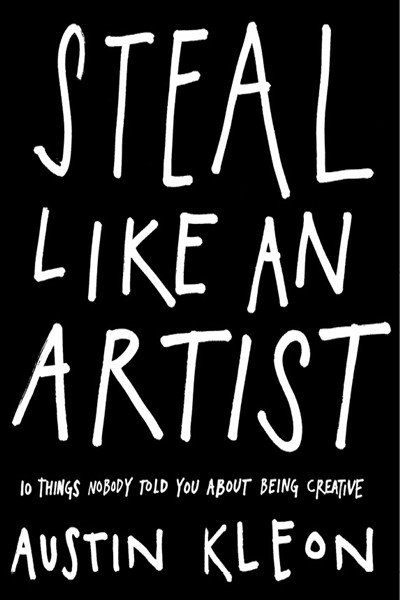
The Two-Step Formula is almost too simple—”Do good work + share it with people” feels reductive but is probably accurate. The genealogy method of building your family tree of influences by following what your heroes loved is brilliant and immediately actionable. Kleon’s hand-lettered visual style is charming, making abstract concepts concrete and inviting in a way that pure text couldn’t achieve.
🔑 Key Concepts
-
The Art of Stealing vs. Plagiarism: Plagiarism is trying to pass someone else’s work off as your own. Stealing is copying from many sources and transforming them into something new that only you could make. The artist is a collector who collects selectively, only things they really love. You’re only going to be as good as the stuff you surround yourself with. Don’t just steal the style, steal the thinking behind the style. You don’t want to look like your heroes, you want to see like your heroes.
-
Imitation → Emulation → Innovation: Start by imitating your heroes (copying to learn). Move to emulation (adapting their approach to your context). Your failure to perfectly copy reveals your unique voice. “It is our failure to become our perceived ideal that ultimately defines us and makes us unique” (Conan O’Brien). Copy your heroes, examine where you fall short, what’s in there that makes it yours. That’s the stuff to amplify.
-
The Genealogy Method: Study one hero deeply, then find three people they loved. Repeat this process to build your “family tree” of influences. Dig into their recommendations, their heroes, their inspirations. Chew on one thinker’s work and follow their references. Go deeper than anyone else to get ahead. Climb your own family tree and discover your own past.
-
Analog-to-Digital Loop: Use analog tools (paper, pen) for idea generation because computer kills creativity by making deletion too easy. Use digital tools (computer) for editing and publishing. Keep two workstations: one for creating (analog), one for finishing (digital). The computer is really good for editing ideas and really bad for generating ideas. A computer is a distraction machine.
-
Productive Procrastination: Work on multiple projects simultaneously. “The work you do while you procrastinate is probably the work you should be doing for the rest of your life” (Jessica Hische). Side projects often become the main event. Take time to be bored—that’s where ideas come from. Practice productive procrastination: when you’re avoiding one project, work on another. Have many projects going so boredom never sets in.
🧠 Mental Models & Frameworks
-
1+1=3 Principle: Use this when generating new creative ideas. When two ideas come together, they create a third thing (negative space). Creativity emerges from combining existing elements in new ways. The mashup is the method. All new ideas are just mashups or remixes of previous ideas. When stuck, take two unrelated ideas you love and force them together—the collision creates something neither could alone.
-
Embrace Obscurity: Use this early in your creative career when nobody knows your name. Being unknown is a gift—you have freedom to experiment without pressure. Enjoy it while it lasts. Make use of your obscurity while you have it. Make things for as long as you can without anyone caring. Once people care, everything changes. Instead of lamenting lack of audience, exploit it by taking wild creative risks and failing in public while nobody’s watching.
-
The Two-Step Formula: Use this when building your creative career. Step 1: Do good work (focus on craft, put in hours, make things worth sharing). Step 2: Share it with people (get online, show your process, be findable). Both steps are equally essential. Stop waiting until work is “perfect” to share—start a blog, post work-in-progress, document your learning and combine quality work with generous sharing.
-
The Genealogy Tree: Use this when developing taste and finding influences. Pick one artist you love. Find out three artists they love. Research those artists. Find three artists each of them loved. Keep going. You’ll trace back centuries and sideways into adjacent fields. This builds your unique constellation of influences. Read your heroes’ interviews, find who they name-check, follow those threads, and build a visual map of your creative ancestry.
-
Constraints as Creative Freedom: Use this when feeling paralyzed by infinite possibilities. Limitations paradoxically enable creativity. Infinite possibilities are paralyzing; constraints are liberating. Dr. Seuss wrote “Green Eggs and Ham” using only 50 words. Tell yourself you have all the time in the world and nothing will get done. Tell yourself you have limited time and watch what happens. Set artificial constraints (write 50-word story, make art using only three colors, finish in 30 minutes) and let the limits force creativity.
💬 My Favorite Quotes
What a good artist understands is that nothing comes from nowhere. All creative work builds on what came before. Nothing is completely original.
Don’t just steal the style, steal the thinking behind the style. You don’t want to look like your heroes, you want to see like your heroes.
In this age of information abundance and overload, those who get ahead will be the folks who figure out what to leave out, so they can concentrate on what’s really important to them.
🙋 Who Should Read It?
-
Aspiring creatives paralyzed by impostor syndrome who feel they need to be “original” before starting, artists stuck waiting to “find their voice,” or anyone struggling with writer’s block and creative paralysis.
-
People who think creativity is mystical talent they lack rather than learnable skill, mid-career creatives feeling stale who need permission to steal and remix, or creators worried about being derivative and obsessing over originality.
-
People with day jobs who think they need to quit to be “real” artists, or artists ashamed of their influences thinking they should hide who they copy from.
🔗 Additional Resources
Austin Kleon’s Other Books:
- “Show Your Work!” (companion on sharing creative process)
- “Keep Going” (sustaining creative practice)
- “The Steal Like an Artist Journal” (practical exercises)
Books on Remix Culture and Influence:
- “Everything is a Remix” by Kirby Ferguson
- “The Ecstasy of Influence” by Jonathan Lethem
Books on Creative Practice:
- “The War of Art” by Steven Pressfield
- “Big Magic” by Elizabeth Gilbert
- “The Artist’s Way” by Julia Cameron
- “Bird by Bird” by Anne Lamott
- “On Writing” by Stephen King
- “Daily Rituals” by Mason Currey
Concepts Referenced:
- T.S. Eliot on immature vs. mature poets
- Pablo Picasso: “Art is theft”
- Conan O’Brien on failure to become ideal defining us
- Jessica Hische on productive procrastination
- Gustave Flaubert on being boring in life to be original in work