⚡ The Lightning Summary
The Digital Age has fundamentally changed how businesses can operate, allowing small teams (4-12 people) to build highly profitable, location-independent businesses that deliver creative, location and time freedom. By shifting from selling time and skills to creating digital assets (IP, media, data, technology), targeting affluent niche markets instead of the mass market, and manufacturing demand rather than just supply, entrepreneurs can build sustainable businesses generating 8-figure revenues while working remotely and maintaining complete autonomy.
⭐ The One Thing
The one thing this book taught me: Your lifestyle business isn’t about working harder or having the best product—it’s about leveraging the unique convergence of digital technology, AI and decentralized systems to create scalable assets that deliver value without being tied to your time, location or physical presence. Small teams now have infinite leverage that was previously only available to massive corporations.
💭 First Impressions
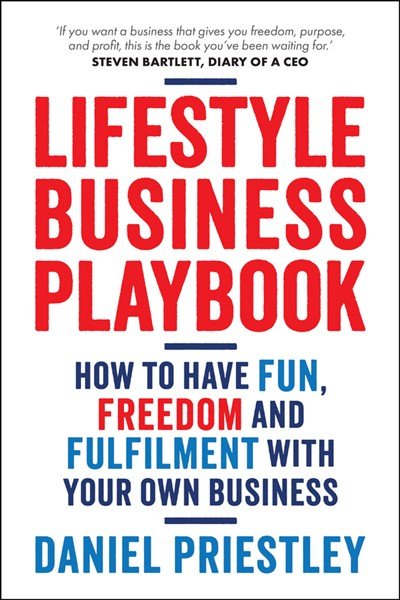
The book’s timing feels incredibly relevant given the AI revolution and remote work normalization post-Covid. Priestley’s personal story of building and losing multiple businesses before finding the right formula adds credibility and makes the framework feel battle-tested rather than theoretical. The emphasis on deliberately keeping businesses small (4-12 people) contradicts the typical “scale at all costs” mentality pervasive in entrepreneurship circles. This counterintuitive wisdom about having “enough” rather than endless growth feels refreshing and aligned with what actually creates fulfillment. The seven shifts framework provides a clear mental model for understanding why traditional business approaches no longer work.
🔑 Key Concepts
-
The Value Hierarchy: Moving up from unskilled labor → skilled labor → intellectual property → media assets → data → technology. Most people are stuck at the skilled labor level, trading time for money. Freedom comes from creating assets at the higher levels that scale independently of your time. The school system only revealed the base levels, trapping people in outdated models.
-
The 4-12 Person Sweet Spot: The optimal lifestyle business has 4-12 team members. Below 4, everything falls on your shoulders and you can’t take a real break. Above 12, you need teams of teams, HR managers, investors and complex hierarchies that kill the fun and flexibility. This size delivers the best of all worlds—not lonely, not crowded, highly leveraged with AI.
-
Manufacturing Demand Over Supply: Success isn’t about having the best product but about manufacturing desire for it. Rolex makes more profit than the rest of the mechanical watch industry combined not because their watches are objectively better, but because they’ve perfected the art of creating scarcity and desire. Your marketing assets are more valuable than your product.
-
Digital Assets as Freedom: Anything that delivers value even if you and your team disappeared qualifies as a digital asset. Seven categories: IP assets, brand assets, market assets, product assets, systems assets, culture assets and funding assets. In 1970, 20% of S&P 500 value was intangible; by 2025 it’s 95%. Ones and zeros are worth more than concrete and steel.
-
The Three Freedoms: A true lifestyle business delivers creative freedom (work on projects you’re passionate about with niche communities), location freedom (live and work from anywhere) and time freedom (structure your day without direct relationship between time working and money earned). These three elements, now possible due to technology, define the lifestyle business model.
🧠 Mental Models & Frameworks
-
The CAOS Method: Use this when scouting new business opportunities. Systematically explore four dimensions: Concept (is the idea worth pursuing?), Audience (can you get attention from the right people?), Offer (can you present the right people with what they want?), Sales (can you get sales flowing at an allowable cost?). Each dimension must validate before moving to the next.
-
The LAPS Dashboard: Use this for tracking business performance weekly. Monitor four key metrics: Leads (people expressing interest), Appointments (scheduled conversations), Presentations (formal pitches delivered), Sales (closed deals). Establish clear conversion ratios between each stage. Set weekly targets for each metric and track obsessively.
-
The Perfect Repeatable Week: Use this when building sustainable revenue. Design a weekly campaign that repeats without variation—same lead generation, same conversion activities, same delivery rhythm. Once you find your formula, repeat it over and over. Stop reinventing your marketing every week and run one powerful campaign 40-45 weeks per year.
-
The Three Campaigns System: Use this for maintaining consistent growth. Run simultaneously: (1) Perfect Repeatable Week for steady pipeline, (2) Quarterly Spotlight for momentum and showcasing, (3) Annual Big Message for thought leadership and brand building. Each serves different purpose and timeline.
-
The Pause, Reflect, Document Framework: Use this for discovering your intellectual property. Regularly ask: “When did I do something special, for a certain type of person, where we got a valuable result and I can explain it step by step?” Schedule monthly walks in nature with just a notepad. This “unproductive” time can be your highest-paid work because it transforms experiences into scalable assets.
💬 My Favorite Quotes
The more your life is repetitive drudgery, the less you will earn because technology can do it better, faster, cheaper and safer than you. The more you do things that are playful, silly, fun, wild, adventurous, creative and messy, the more you will be able to earn.
We don’t make profit for creating wonderful products and services. We make a profit when we manufacture excess demand for our wonderful products and services.
Success is the point where more money or a bigger business wouldn’t meaningfully add to your lifestyle.
🙋 Who Should Read It?
-
Skilled professionals or consultants who feel trapped trading time for money and want to build scalable digital assets that generate income without constant client work. If you’re excellent at what you do but realize your income is capped by available hours, this book provides the exact playbook for transitioning from skilled labor to IP-based business.
-
Existing small business owners (1-25 employees) who are overwhelmed by operational complexity and want to deliberately structure their business for freedom rather than endless growth. If you’ve built something successful but feel like a prisoner to your creation, this shows how to redesign for the 4-12 person sweet spot.
-
Corporate professionals in their 30s-50s who sense the Industrial Age career path is dying and want to future-proof themselves before AI makes their roles obsolete. If you’re highly skilled but worried about job security and yearn for autonomy, this provides a concrete roadmap for entrepreneurial transition.
🔗 Additional Resources
Books Referenced:
- Never Split the Difference by Chris Voss
- Main Street Millionaire by Codie Sanchez
- Mating in Captivity by Esther Perel
- Key Person of Influence (Priestley’s earlier work)
Tools and Platforms:
- ScoreApp.com – Online assessments, quizzes, waiting lists
- 24Assets.com – Assessment for discovering your digital asset ecosystem
- Dent.global – Coaching and accelerator programs
- BookMagic.ai – AI-powered book writing software
- AwardsApp.ai – Platform for entering and winning business awards
Related Frameworks:
- The Five Keys to Becoming a Key Person of Influence: Pitching, Publishing, Products, Profile, Partnerships
- The Seven Categories of Digital Assets
- The Four Sources of Income: Allocated Benefits, Wages, Performance Income, Asset Income