
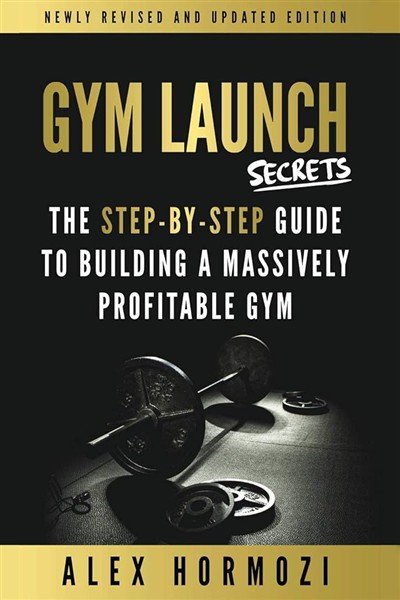
⚡ The Lightning Summary
Gym owners fail because they use broken low-ticket acquisition models, commodity pricing and have massive attrition holes. The solution: client-financed acquisition (get paid to acquire customers via $500-600 challenges), premium pricing ($167-225/month for large group, $500-700 for semi-private), and systematic retention that cuts churn from 10% to 3%. Pull three macro profit levers (Price, Capacity, Overhead) to transform a struggling gym from barely breaking even to $30,000+ monthly profit without opening a new location.
⭐ The One Thing
The one thing this book taught me: He or she who frames the problem owns the solution. Stop reacting to what clients think they want (cheap memberships, unlimited access) and start educating them on what you know they need (accountability, defined-end programs with deadlines, premium service). The moment you position your gym as a results-focused coaching business that happens to have a facility (not a facility that happens to have coaches), you unlock the ability to charge premium rates, achieve negative client-acquisition costs and build a massively profitable gym.
💭 First Impressions
I was surprised by the emphasis on billing cycles—switching from monthly to 28-day adds 8% revenue (64% increase in take-home at 12% margins). The client-financed acquisition model blew my mind: make $1,200 spending $100 on ads (12:1 return on Day 1). Alex is brutally honest, admitting he didn’t start his gym out of passion but fear of failure, which is refreshingly real. The book isn’t just about fitness—it’s a masterclass in service business economics that applies to any recurring revenue model.
🔑 Key Concepts
-
The Three Main Problems: (1) Broken client-acquisition system that costs too much money and time, (2) Broken revenue model where gym is full but barely profitable, (3) Hole-in-the-bucket attrition problem where you can’t hang on to clients. Traditional gym model copies big-box gyms owned by private equity with deep pockets. Small gym owners play by different rules—if you play their game by their rules, you will lose every single time.
-
Client-Financed Acquisition: Instead of low-barrier offers ($21 for 21 days), charge $500-600 for “FREE” Six-Week Challenge where they get money back if successful. Day 1: spend $100 on ads, get 10 leads, schedule 7, 3-4 show, sell 2 at $600 = $1,200 revenue from $100 spend (12:1 return). Day 4: made $3,600, payment processors release $2,400, covered ad spend with $2,000 net profit. Everything else is pure profit. You make money acquiring customers (negative client-acquisition cost).
-
The Virtuous vs Vicious Price Cycle: When you decrease prices, client emotional investment decreases, perceived value decreases, results decrease, clients become more demanding (cheapest customers ask for most), you provide less service, profit per customer decreases, your self-value decreases. When you increase prices, the opposite happens—client results increase because they’re invested, and you can provide better service because you’re profitable. If you want to actually help people, you need to charge more.
-
The Buying Curve (Watermelon Curve): Four fulfillment zones: (A) Self-Service $0-99 (Planet Fitness, don’t compete here), (B) Large Group $167-225 for 16+ people (where you want to be), (C) Medium Group $250-399 for 5-15 people (NO MAN’S LAND, avoid at all costs), (D) Small Group/Semi-Private $500-700 for 1-on-4 (highest service, 4x revenue per time slot vs one-on-one). Offer only two tiers: Large Group and Semi-Private.
-
The Pie Equation: (New sign-ups from referrals + marketing) ÷ % leaving = Hypothetical Gym Max. Example: 10 sign-ups ÷ 10% churn = 100 max EFTs. Double marketing to 20 sign-ups with same 10% churn = 200 max. Cut churn to 5% with same 10 sign-ups = 200 max. Do both (20 sign-ups + 5% churn) = 400 max EFTs. Quadrupled gym’s capacity by improving acquisition AND retention. Most gyms only focus on acquisition and ignore the hole in the bucket.
🧠 Mental Models & Frameworks
-
The Three Macro Profit Levers: Use this when diagnosing why a gym is full but not profitable. (1) Price Levers (number of members, billing cycle, price per member), (2) Capacity Levers (sessions per week, session duration, membership levels, attendance, physical space, exercise selection), (3) Overhead Levers (sessions fulfilled, total work hours, cost of work hours). Pull all three levers simultaneously to maximize profit. When business feels “full” but not profitable, diagnose which levers haven’t been pulled yet instead of assuming you need to scale horizontally.
-
Downsell Your Upsell: Use this when structuring offers to maximize lifetime value. No one wants a membership—they want a result and a deadline. People will pay 2-4x the price for something NOT on continuity. Charge premium ($100/week for 12-week defined-end program) when excitement is highest, then “downsell” to continuing at $50/week afterward. Charging double at beginning when most committed makes $200/month membership seem like bargain. Gyms using this keep double the industry average at 58% higher price.
-
The C-L-O-S-E-R Sales Formula: Use this when selling cold traffic fast. (C) Clarify why they showed up, establish GAP between where they are and where they want to be, (L) Label them with problem you plan to solve, get their stats, show what was missing in past attempts, (O) Overview past pains and experiences, align with what worked, contrast with what didn’t, (S) Sell them the “vacation”, qualify them on Fitness, Nutrition, Accountability, (E) Explain away their concerns (only 3 real obstacles: stalls, decision-making, price), (R) Reinforce their decision with handwritten invitation, call from owner, t-shirt/swag to prevent back-outs. Make all sales conversations exactly the same for consistent outcomes.
-
Two-Tier Regressive Programming: Use this when solving onboarding problems and space constraints. For every workout, create second easier version done in parallel. Tier 1 for experienced clients (BB Back Squat, BB Bench Press, BB Row), Tier 2 for new clients (Goblet Squat with KB, Push-ups From Knees, Double KB Row). Same muscles and movement patterns, just regressive. Removes steep learning curve, integrates new people immediately, eliminates need for special beginner sessions, increases capacity. Stop creating separate beginner programs that segregate new customers.
-
Weapons-Grade Compassion: Use this when building competitive advantage. Taking full responsibility for another person’s state (employees or clients) and taking action as a result. Comes from place of abundance—you have enough of everything you need, so can focus on them instead of you. People can FEEL when you operate from this place. Customers come for meeting fitness goals but stay for things they didn’t know they needed (friendly hello, encouragement, invitations, competition, knowing staff by name, impromptu reach-outs, cards, calls when miss workout, flowers when mom passes).
💬 My Favorite Quotes
He or she who frames the problem owns the solution.
No one wants a membership. They want a result and a deadline.
If you want to actually help people, not just say you are, you need to charge more.
🙋 Who Should Read It?
-
Gym owners stuck at 80-120 members who feel like they’re working 80+ hours per week but taking home less than $2,000/month. Your gym feels “full” at peak times but you’re barely covering overhead and can’t understand why you’re still broke.
-
Personal trainers transitioning to gym ownership who need to understand the fundamental business model differences between training clients one-on-one and running a profitable facility at scale. You’re great at coaching but have no framework for acquisition, pricing or retention systems.
-
Any service business owner selling recurring revenue subscriptions who struggles with acquisition costs, pricing psychology, capacity constraints and retention. The principles (client-financed acquisition, premium pricing, systematized retention) apply far beyond fitness.
🔗 Additional Resources
Books on Offers and Pricing:
- $100M Offers by Alex Hormozi (detailed framework for offer creation)
- $100M Leads by Alex Hormozi (lead generation strategies)
- Profit First by Mike Michalowicz (cash flow management for small businesses)
- The Personal MBA by Josh Kaufman (business fundamentals)
Books on Sales and Persuasion:
- Influence: The Psychology of Persuasion by Robert Cialdini (scarcity, urgency, social proof)
- Pre-Suasion by Robert Cialdini (framing and context before the ask)
- To Sell Is Human by Daniel Pink (modern sales psychology)
- Never Split the Difference by Chris Voss (negotiation tactics)
Books on Retention and Customer Experience:
- The Effortless Experience by Matthew Dixon (making it easy for customers to stay)
- Unreasonable Hospitality by Will Guidara (creating memorable experiences)
- Setting the Table by Danny Meyer (hospitality as competitive advantage)
Related Thinkers & Experts:
- Russell Brunson (sales funnels and direct response marketing)
- Dan Kennedy (direct response marketing principles)
- Grant Cardone (video texts and 10X mindset)
- Frank Kern (behavioral triggers in marketing)