
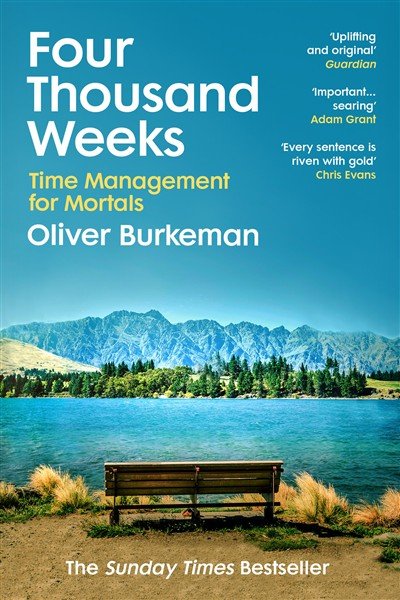
⚡ The Lightning Summary
The average human lifespan is only 4,000 weeks. Our time troubles stem not from having too little time but from our flawed relationship with it—inherited ideas about mastering and controlling time that paradoxically make us more rushed and anxious. True productivity and peace come from embracing our finitude rather than fighting it. Stop trying to get everything done and start choosing what matters.
⭐ The One Thing
The one thing this book taught me: The day will never arrive when you finally have everything under control. Once you accept this, you’re free to stop optimizing and start choosing. The real measure of time management is whether it helps you neglect the right things.
💭 First Impressions
This is an anti-productivity productivity book that challenges the genre’s core assumptions while still offering practical advice. The 4,000 weeks framing is brilliant—it makes the brevity of life visceral and impossible to ignore. The efficiency trap concept explained my own hamster wheel experience perfectly: I’d been measuring success by how much I got done, creating more demands in an infinite loop. Once I admitted the day will never come when everything’s under control, I stopped trying to reach it and started actually choosing.
🔑 Key Concepts
-
The Efficiency Trap: Productivity is a trap. Becoming more efficient just makes you more rushed, and trying to clear the decks simply makes them fill up again faster. This is Parkinson’s Law: “Work expands so as to fill the time available for its completion.” But it goes deeper. The definition of “what needs doing” expands to fill the time you create. Get through your email and more arrives. Finish one project and three more appear. There’s no winning this game because the goalpost moves every time you advance.
-
Embracing Finitude as Liberation: The average human lifespan is approximately 4,000 weeks (80 years). This isn’t depressing; it’s liberating. Once you accept that you’ll never do everything, you’re free to focus on doing a few things that count. Any finite life—even the best one you could imagine—is a matter of ceaselessly waving goodbye to possibility. The word “decide” comes from Latin decidere meaning “to cut off.” Every choice closes infinite alternatives. This is feature, not bug.
-
The Causal Catastrophe: Modern culture treats present moments merely as stepping stones to better future states. As Tom Stoppard wrote via Herzen: “Because children grow up, we think a child’s purpose is to grow up. But a child’s purpose is to be a child. Life’s bounty is in its flow. Later is too late.” This instrumentalization of time—treating now as just a way to get to later—is fundamentally delusional.
-
Time as a Conveyor Belt: We moderns think of time as abstract containers moving past us on a conveyor belt that we must “use well.” Medieval people lived in “task orientation”—you milked the cows when they needed milking, not at 6am sharp. Now we think of time as something separate from life itself, something we possess and must manage. But time isn’t a resource you have. You are time. Your life is made of time.
-
The Attention Economy: Social media is a machine for making us care about the wrong things. What you pay attention to literally defines your reality. There are thousands of people on the other side of the screen being paid to keep you there. Your attention is finite and precious. Where you direct it is how you spend your life.
🧠 Mental Models & Frameworks
-
Fixed Volume Productivity: Use this when managing infinite to-do lists and competing demands. Keep two lists: “open” and “closed.” Open list contains everything you might want to do. Closed list has maximum 10 items. You can’t add to closed list until you complete something and create space. This caps work-in-progress and forces prioritization. Move everything off your main to-do list onto “open” list. Transfer only 10 most important items to “closed” list. Feel the relief of defined boundaries.
-
Surrender to the Speed of Reality: Use this when feeling impatient or trying to force outcomes faster. Patience isn’t gritting your teeth while waiting. It’s surrendering to reality’s pace. The mechanic who takes time to understand what’s wrong before acting gets it fixed faster than one who immediately starts doing things. Notice when you’re trying to make something happen faster than it can. Ask “What is the speed of reality here?” Adjust your pace to match.
-
Strategic Underachievement: Use this when facing impossible demands and obligations. You can’t do everything well, so consciously choose areas where you’ll accept mediocrity or failure. Not “I’ll get to that eventually” but “I’m deliberately choosing to neglect this.” Making these choices explicit reduces guilt and frees energy for what actually matters. List all your roles and responsibilities. Explicitly choose 2-3 where you’ll accept being below average. Write it down. Notice the liberation in conscious choosing versus vague anxiety about everything.
-
Serialization: Use this when juggling multiple projects and getting nowhere. Work on one big project at a time until completion rather than advancing several simultaneously. This feels wrong (what if the others are also urgent?) but actually gets things done faster. Parkinson’s Law applies to projects too—the one project expands to fill time, but then it actually finishes. Multiple projects just create permanent incompletion.
-
The Researcher Attitude Toward Relationships: Use this when feeling frustrated by partners, family or friends not meeting expectations. Approach relationships with curiosity rather than control. Instead of “How can I fix this person to be what I need?” ask “What is this person actually like? How do they operate?” You can’t control others or the fact that relationships take time. You can only show up with interest in who they actually are.
💬 My Favorite Quotes
The average human lifespan is absurdly, terrifyingly, insultingly short. Assuming you live to be eighty, you’ll have had about four thousand weeks.
Productivity is a trap. Becoming more efficient just makes you more rushed, and trying to clear the decks simply makes them fill up again faster.
Because children grow up, we think a child’s purpose is to grow up. But a child’s purpose is to be a child. Life’s bounty is in its flow. Later is too late.
🙋 Who Should Read It?
-
Recovering productivity addicts who’ve tried every system and still feel behind, rushed and inadequate. Burnout survivors realizing that optimizing harder isn’t the answer but not knowing what else to try.
-
High achievers paralyzed by infinite options and the anxiety of choosing wrong. Perfectionists who can’t start, and those trapped in the “when-I-finally” mindset waiting for life to begin after the next milestone.
-
Seekers disappointed by conventional productivity advice that promises you can “have it all.” Anyone feeling existential dread about mortality wondering if there’s a wiser relationship with finite time than panic or denial.
🔗 Additional Resources
Philosophers and Thinkers Referenced:
- Martin Heidegger (being-towards-death)
- Seneca (Roman Stoic, “On the Shortness of Life”)
- Jiddu Krishnamurti (presence, attention)
- Alan Watts (Eastern philosophy, acceptance)
Books and Authors:
- Lewis Mumford – “Technics and Civilization”
- Hartmut Rosa – Social acceleration theory
- James P. Carse – “Finite and Infinite Games”
Practical Tools from Appendix:
- Adopt a “fixed volume” approach to productivity
- Serialize, serialize, serialize
- Decide in advance what to fail at
- Focus on what you’ve already completed, not just on what’s left to do
- Cultivate instantaneous generosity
- Practice doing nothing
Related Productivity Criticism:
- Cal Newport – “Digital Minimalism,” “Slow Productivity”
- Jenny Odell – “How to Do Nothing”
- Tim Wu – “The Attention Merchants”