
⚡ The Lightning Summary
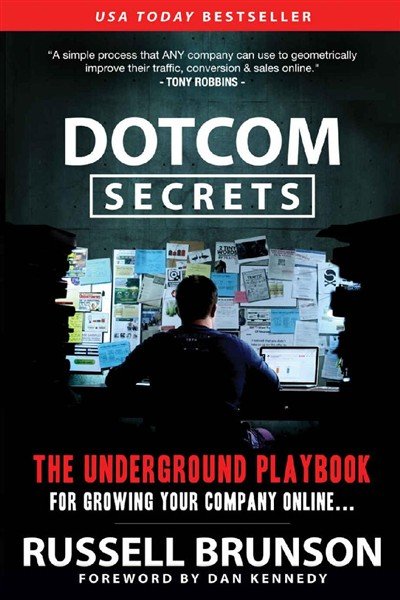
DotCom Secrets reveals the underground playbook for building profitable online businesses through strategic sales funnels and converting traffic into customers. Russell Brunson shows entrepreneurs how to create Value Ladders that ascend customers from free offers to high-ticket programs, build communication funnels using the Attractive Character framework, and reverse engineer successful competitors to shortcut years of trial and error.
⭐ The One Thing
The one thing this book taught me: Your business success isn’t about having the best product or the most traffic—it’s about having the right funnel that moves people through a strategic sequence from stranger to customer to raving fan, with each interaction designed to build value and ascend them up your Value Ladder.
💭 First Impressions
The concept of the Value Ladder fundamentally changed how I think about pricing and offers. Instead of competing on price, Brunson shows how to create multiple value tiers that serve customers at different commitment levels while maximizing lifetime customer value. The Attractive Character framework was surprisingly powerful—I never realized how much personality and storytelling drive online sales until Brunson broke down the exact elements needed to bond with an audience through email and content. Some tactics feel dated in today’s marketing landscape, but the core principles about human psychology, value creation and funnel mechanics remain timeless. The book is more about strategic thinking than tactical execution, which gives it staying power.
🔑 Key Concepts
-
The Value Ladder: Your business needs multiple offers at ascending price points, from free to premium. Each rung serves customers at different commitment levels while naturally moving them toward higher-value purchases. The goal isn’t just to make one sale but to increase customer lifetime value by serving them at progressively deeper levels.
-
The Three Types of Traffic: All traffic falls into three categories—traffic you own (your email list), traffic you control (paid ads), and traffic you don’t control (social media, SEO). Your primary goal is converting all traffic into traffic you own because each email subscriber generates approximately one dollar per month in revenue.
-
The Attractive Character: People buy from people, not faceless brands. You need to create a persona with four elements (backstory, parables, character flaws and polarity) and one of four identities (leader, adventurer, reporter or reluctant hero) that your audience can relate to and follow.
-
The Seven Phases of a Funnel: Every successful funnel has seven critical points: determining traffic temperature, setting up the pre-frame bridge, qualifying subscribers, identifying buyers, identifying hyperactive buyers, age and ascend the relationship, and change the selling environment. Optimizing each phase compounds your results exponentially.
-
Reverse Engineering Success: Instead of reinventing the wheel, find competitors who are already successful and reverse engineer their funnels using tools like SimilarWeb. Study their demographics, offers, landing pages, traffic sources and ad copy. Model what works, then test and improve.
🧠 Mental Models & Frameworks
-
The Value Ladder Model: Use this when structuring products and services. Create four tiers (bait, frontend, middle and backend offers) at ascending price points and value levels, with each tier naturally leading to the next. Before starting any business, map all nine blocks to ensure internal consistency—a Value Proposition promising personalization requires appropriate Key Resources (customer data), Key Activities (analytics) and Customer Relationships (data collection mechanisms).
-
Traffic Temperature Framework: Use this before creating any marketing campaign. Classify traffic as hot (knows you), warm (knows someone who knows you) or cold (strangers) and customize your message accordingly. Hot traffic needs personality-driven content, warm needs endorsements, cold needs extensive pre-framing. This helps avoid the mistake of treating all traffic the same and explains why some campaigns convert while others fail.
-
The Soap Opera Sequence: Use this when onboarding new email subscribers. Send a 5-day email sequence that opens with high drama, shares backstory, reveals epiphany, highlights hidden benefits and closes with urgency. Each email opens loops that pull readers to the next message. Email open rates and early engagement skyrocket after implementing this structured onboarding instead of random welcome emails.
-
The Enquirer Interrupt: Use this when creating ads for congregations where your ideal customers hang out. Use unusual images and shocking headlines (like National Enquirer covers) to interrupt people’s attention and get them to click away from what they’re currently doing. This reframes ad creation as attention-grabbing interrupts rather than polite introductions.
-
Pre-Frame Bridge Concept: Use this before sending traffic to any landing page. Consider the frame of mind your traffic is in before they arrive and create a bridge (email, article, video) that puts them in the optimal mental state for your offer. Build bridges for every traffic source instead of sending everyone to the same page and wondering why conversions vary.
💬 My Favorite Quotes
Ultimately, the business that can spend the most to acquire a customer wins.
You could read a million books on Jiu Jitsu, but that’s not gonna help you in a street fight.
Don’t try to reinvent the wheel. That’s the secret. That’s how you take a decade of hard work and compress it down into a day’s worth of time and effort. Find what someone else has already done and model it.
🙋 Who Should Read It?
-
Online business owners struggling to convert traffic into sales consistently. If you’re getting visitors but not buyers, or your conversion rates seem stuck no matter what you try, this book provides the strategic funnel framework that’s probably missing from your approach.
-
Entrepreneurs who rely too heavily on one product or one price point. If you’re stuck in a feast-or-famine cycle because you only have one offer, the Value Ladder concept will transform how you structure your business and dramatically increase customer lifetime value.
-
Marketers who treat all traffic the same and wonder why their campaigns produce wildly inconsistent results. If you’re sending cold Facebook traffic to the same page as your warm email subscribers and confused about the poor performance, the traffic temperature framework will be a revelation.
🔗 Additional Resources
Books Cited and Related:
- Expert Secrets by Russell Brunson (companion book on building authority and selling from stage/webinars)
- Traffic Secrets by Russell Brunson (third book in the trilogy focusing on getting traffic)
- Sway: The Irresistible Pull of Irrational Behavior by Ori and Rom Brafman (pre-framing research)
Tools and Software Mentioned:
- ClickFunnels (www.ClickFunnels.com) – Brunson’s funnel-building software platform
- SimilarWeb (www.SimilarWeb.com) – Competitive research tool for reverse engineering funnels
Key Concepts and Methodologies:
- Value Ladder framework for structuring product offerings
- Soap Opera Sequence for email onboarding
- Seinfeld Sequence for daily broadcast emails
- Perfect Webinar script for selling from presentations
- Two-step application process for high-ticket sales
Related Experts and Influences:
- Dan Kennedy (direct marketing and customer acquisition)
- Tony Robbins (modeling success and psychology)
- Gene Schwartz (copywriting and awareness stages)
- Andre Chaperon (email marketing and Soap Opera Sequences)