⚡ The Lightning Summary
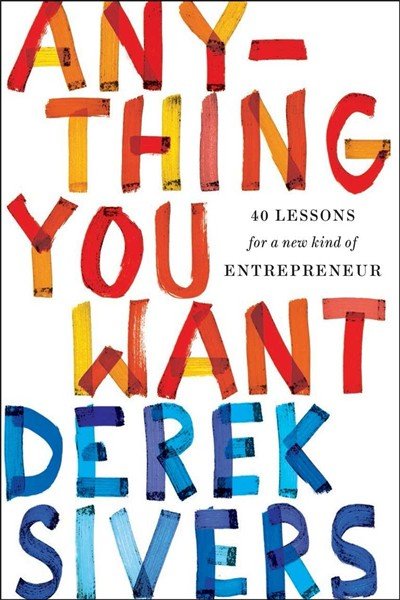
Derek Sivers built CD Baby from a $500 hobby into a $22 million business by obsessively serving musicians and rejecting traditional growth rules. The core lesson: business should be your personal utopia that makes customers’ dreams come true. Success means staying true to your values, knowing when you have enough and choosing being over having.
⭐ The One Thing
The one thing this book taught me: Business is not about money, size or following conventional rules. It’s about creating your perfect world while helping others achieve their dreams. You control the laws of your business universe, so design it as a utopia that reflects your values and makes you genuinely happy.
💭 First Impressions
What grabbed me immediately was how refreshingly honest Sivers is about the founder journey without the typical startup hero worship. His casual writing makes profound business wisdom feel accessible, and his radical customer service philosophy flows naturally from clear values. The “Hell yeah! or no” principle hit hard as something I intellectually knew but rarely practiced, while the $22 million charity donation proved this wasn’t just philosophy but deeply lived values. His vulnerability about mistakes (the $3.3 million buyback, delegation failures) made the success lessons more credible, and the short format is perfect because each lesson stands alone but builds to a cohesive worldview.
🔑 Key Concepts
-
Business as Personal Utopia: When you make a company, you create your perfect world where you design the rules. You can make your role anything you want. You’re the dictator of your own little universe. This means you have complete freedom to create a business that reflects your values and makes you happy, rather than imitating what others do or following industry norms blindly.
-
Customer Dreams Over Personal Gain: Business should be about making dreams come true for others and yourself, not primarily about money. Never forget that absolutely everything you do is for your customers. Care about your customers more than yourself. This flips the typical business focus from “what can I extract” to “how can I serve,” which paradoxically leads to better business outcomes and personal satisfaction.
-
The “Hell Yeah! or No” Filter: When deciding whether to commit to something, if you’re not saying “Hell yeah!” about it, say no. Most people say yes to too much, leaving no time for the rare things that make them truly excited. This principle forces intentionality about where you invest your limited time and energy, ensuring you’re only pursuing what genuinely matters.
-
Execution is Everything: Ideas are just a multiplier of execution. The most brilliant idea with no execution is worth $20, while a mediocre idea with brilliant execution is worth $50 million. Too many people overvalue ideas and undervalue the hard work of actually building and iterating. Success comes from persistently improving and inventing, not from persistently promoting what doesn’t work.
-
Enough is Enough: Know when you have enough money, employees, customers and growth. More isn’t always better. Derek was happier with 5 employees than 85, and happiest working alone. The constant pressure to grow bigger often conflicts with staying happy and maintaining the quality that made you successful in the first place.
🧠 Mental Models & Frameworks
-
The Idea/Execution Multiplier: Ideas are rated from -1 (awful) to 20 (brilliant), execution from $1 (none) to $10M (brilliant), then you multiply them. Even brilliant ideas (20) with no execution ($1) equal $20. Mediocre ideas (5) with brilliant execution ($10M) equal $50 million. Stop waiting for the perfect idea and start executing on decent ideas exceptionally well.
-
Prepare to Double: Always design systems to handle exactly twice your current volume. If you have 10 clients, design for 20. If your warehouse is 5,000 sq ft, rent 10,000. Never do “more of the same” but instead streamline processes for scale. Building in 100% capacity buffer prevents the frantic scrambling that kills quality when growth happens.
-
Trust But Verify: Give people autonomy and power to make decisions (trust), but build in verification systems to ensure critical tasks actually get completed (verify). Both elements are essential and neither alone is sufficient. Explain the philosophy behind decisions so people can decide independently while creating accountability checkpoints for mission-critical work.
-
Being vs. Having: Focus on who you want to become (being) rather than what you want to accumulate (having). To have something is the means, not the end. To be something is the real point. When you sign up for a marathon, you don’t want a taxi to the finish line. The journey of becoming matters more than the destination of having.
-
The 1% Vision Start: Start with 1% of your grand vision using only what you have today. Want international schools? Teach one person this week. Want an airline? Lease a small plane with others who need the same flight. CD Baby started as just helping friends sell CDs online. Virgin Atlantic started by sharing a charter flight.
💬 My Favorite Quotes
When you make a company, you make a utopia. It’s where you design your perfect world. If you ever do want to build a big company, remember this: You’re the one who makes the rules in your little universe.
If you’re not saying ‘Hell yeah!’ about something, say no. When deciding whether to commit to something, if I feel anything less than ‘Wow! That would be amazing! Absolutely! Hell yeah!’ then my answer is no.
Ideas are just a multiplier of execution. To me, ideas are worth nothing unless they are executed. They are just a multiplier. Execution is worth millions.
🙋 Who Should Read It?
-
Solo founders and bootstrapped entrepreneurs who feel pressure to raise funding, scale fast and follow conventional startup wisdom but sense there might be another way to build something meaningful.
-
Business owners at growth inflection points questioning whether success should be measured by revenue and size or by personal happiness and customer satisfaction, especially those who feel guilty about not wanting to grow bigger.
-
Anyone considering taking investor money, preparing to delegate and scale, or experiencing burnout from growing too big and needing permission to stay small and intentional.
🔗 Additional Resources
Books Cited by Author:
- The $100 Startup by Chris Guillebeau (similar philosophy on starting small)
- Seth Godin’s work on permission marketing and tribes (Derek credits Seth’s “If you care, sell” advice)
- Richard Branson biographies (Virgin Atlantic airport story referenced)
Related Thinkers and Experts:
- Paul Graham on doing things that don’t scale and staying small
- Jason Fried and DHH (Basecamp founders) on staying small and profitable
- Naval Ravikant on wealth creation without selling your time
- Nassim Taleb on skin in the game and avoiding fragility
- Tim Ferriss on lifestyle design and the 4-Hour Workweek
Complementary Frameworks from Other Sources:
- Jobs-to-be-Done theory (Clay Christensen) for understanding what customers really want
- Traction by Gabriel Weinberg for systematic marketing channel testing
- The Mom Test by Rob Fitzpatrick for customer research
- Profit First by Mike Michalowicz for financial systems that ensure sustainability
- The E-Myth Revisited by Michael Gerber on systematizing businesses