
⚡ The Lightning Summary
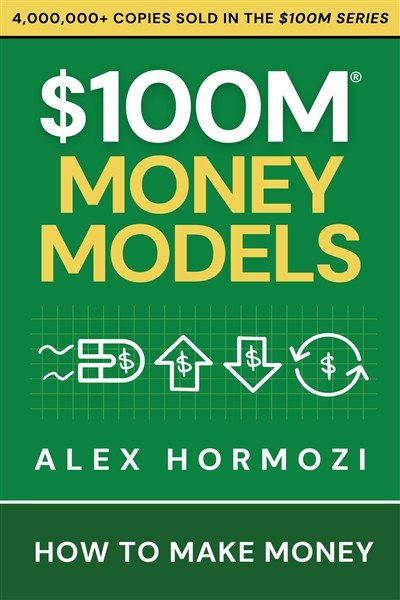
Most businesses fail not because they can’t get customers, but because they run out of cash while trying to grow. Hormozi’s $100M Money Models teaches you how to design a sequence of offers that makes more money from one customer in 30 days than it costs to acquire and service multiple customers. By mastering Attraction, Upsell, Downsell and Continuity offers, you eliminate cash as a growth constraint and build a business that prints money.
⭐ The One Thing
The one thing this book taught me: You don’t get customers to make sales, you make sales to get customers. The real business begins AFTER someone buys for the first time. Your job is to create a deliberate sequence of offers that maximizes customer value while generating enough cash in the first 30 days to fund unlimited customer acquisition.
💭 First Impressions
What immediately struck me is how this book completes Hormozi’s trilogy perfectly: $100M Offers taught what to sell, $100M Leads how to get customers and now $100M Money Models reveals how to actually monetize them. I was shocked to learn Gym Launch went from $476K/month to $4.4M/month primarily through better offer sequencing, not more leads. That’s proof that monetization trumps acquisition. Don’t be fooled by the simplicity. This is sophisticated revenue architecture made accessible with specific templates and pricing multiples, not just theory.
🔑 Key Concepts
-
The Money Model: A deliberate sequence of offers that determines what you offer, when you offer it and how you offer it. The goal is to make more profit from one customer in the first 30 days than it costs to get and service multiple customers. This eliminates cash as a growth bottleneck and allows unlimited scaling. Most businesses fail not from lack of customers but from running out of cash during growth, and a proper Money Model solves this permanently.
-
The Four Types of Offers: Every offer fits into one of four categories. 1) Attraction Offers turn strangers into customers while generating upfront cash. 2) Upsell Offers get customers to spend more money faster. 3) Downsell Offers convert “no” into “yes” by changing how they pay or what they get. 4) Continuity Offers create recurring revenue and maximize lifetime value. Together, these four offer types work in sequence to maximize cash flow and customer value.
-
The 30-Day Rule: The defining metric of a Money Model is whether you can make enough profit from one customer in 30 days to cover the cost of acquiring multiple customers. If you can do this, you’ve eliminated cash as a constraint. You can acquire customers infinitely because each one pays for several more within a month. This is why some businesses scale effortlessly while others struggle despite having customers.
-
“You Can’t Have X Without Y”: The fundamental principle of upselling. Once someone commits to a goal or purchase, they become aware of adjacent problems they need to solve. Your job is to offer solutions to these problems the moment they become aware of them. The car dealership sells insurance when you buy the car. The fitness program sells nutrition when you start training. Timing is everything.
-
The Virtuous Cycle of Making Offers: Making one offer works better than making none. Making more offers works better than making one. When you make more offers and people buy them, you make more money. When you make more money, you can acquire more customers. More customers means more opportunities to make offers. This cycle compounds infinitely once you start it.
🧠 Mental Models & Frameworks
-
The Problem-Solution Cycle: Every offer solves a problem and creates a new one. Buying a car solves transportation but creates the problem of needing insurance. Starting a workout program solves fitness but creates the need for nutrition guidance. Your upsells should solve the problems your main offer creates. Map out the journey and ask what problems emerge after someone buys, then offer solutions to each.
-
The Hyper Buying Cycle: When people commit to something new (weddings, babies, new hobbies, moving), they enter a short window where they’ll spend heavily. A bride-to-be will buy a dress, venue, photographer, flowers, cake and honeymoon in 6-12 months. After the wedding, she stops buying wedding stuff forever. Make ALL your offers during the hyper buying cycle, not after. When someone becomes a customer, they’re in their hyper buying cycle for your solution.
-
The Economist Play: Present three options where option C (both A+B combined) costs the same as the more expensive option B alone. This makes C the obvious choice because people see they’re getting A for free. Example: Web-only subscription $59, print-only $125, web+print $125. Nobody chooses print-only and everyone chooses web+print because they “get web free.”
-
Seesaw Downselling: Frame the payment plan as the negative option, not the benefit. “Would you rather have giant monthly payments or tiny ones?” Then present Option A (giant payments) at $2,000/month for 12 months and Option B (tiny payments) at $24,000 upfront. When you frame it this way, Option B looks better because they “save” monthly payments. Then offer a real compromise at $12,000 down with $1,000/month for 12 months.
-
BAMFAM (Book-A-Meeting-From-A-Meeting): Never let a customer leave without scheduling the next interaction. At the end of every session, appointment, delivery or purchase, immediately schedule the next one. This prevents drop-off and creates natural opportunities to make your next offer. If they won’t schedule, that’s a signal they’re not staying so address it immediately.
💬 My Favorite Quotes
Risk comes from not knowing what you’re doing.
Simple Scales. Fancy Fails.
You can shear a sheep for a lifetime, but you can only skin it once.
🙋 Who Should Read It?
-
Entrepreneurs who have customers but struggle with cash flow. You’re getting customers but running out of money trying to grow.
-
Business owners who only sell one thing and wonder why scaling is so hard. You don’t have a business, you have a front end.
-
Anyone with a working offer who wants to 3-10x revenue without getting more customers. Better monetization beats more traffic.
🔗 Additional Resources
Books Referenced:
- “$100M Offers” by Alex Hormozi (creating irresistible offers)
- “$100M Leads” by Alex Hormozi (customer acquisition)
- The rental car industry’s pricing strategies (case study throughout book)
Related Frameworks:
- The Value Ladder (Russell Brunson) – ascending transaction model
- The Profit First system (Mike Michalowicz) – cash management
- Jobs To Be Done framework – understanding what customers really want
- The SaaS metrics framework (LTV, CAC, MRR, churn)
Hormozi’s Other Resources:
- Acquisition.com – Free training and resources
- Gym Launch – Case study of Money Model in action ($476K to $4.4M/month)